50 House Construction Mistakes Homeowners Make in Hyderabad — And How to Avoid Them
Building a house is one of the biggest investments most homeowners make. In Hyderabad, construction costs can quickly increase when planning is incomplete, drawings keep changing, materials are not properly monitored, or contractor payments are made without proper measurement verification.
Many construction problems are not caused by one major mistake. They happen because several small mistakes are ignored during planning, structural work, material procurement, execution, and quality inspection.
This guide covers 50 common house construction mistakes homeowners make in Hyderabad and explains how to avoid them.
Whether you are building an independent house, duplex, villa, or G+1/G+2 residential building, this checklist can help you improve cost control, construction quality, structural safety, and project transparency.
Why Do Homeowners Make Construction Mistakes?
Most homeowners are not construction professionals. They may have limited experience with:
- Architectural drawings
- Structural drawings
- BOQs
- RCC reinforcement
- Concrete specifications
- Material testing
- Contractor measurements
- Construction schedules
- Waterproofing
- Plumbing and electrical works
- Payment verification
A contractor may complete the work, but the homeowner still needs an independent system to verify whether the work is being executed according to the approved drawings, specifications, and agreed scope.
This is where proper construction project management and QA/QC inspection can make a significant difference.
1. Planning Mistakes
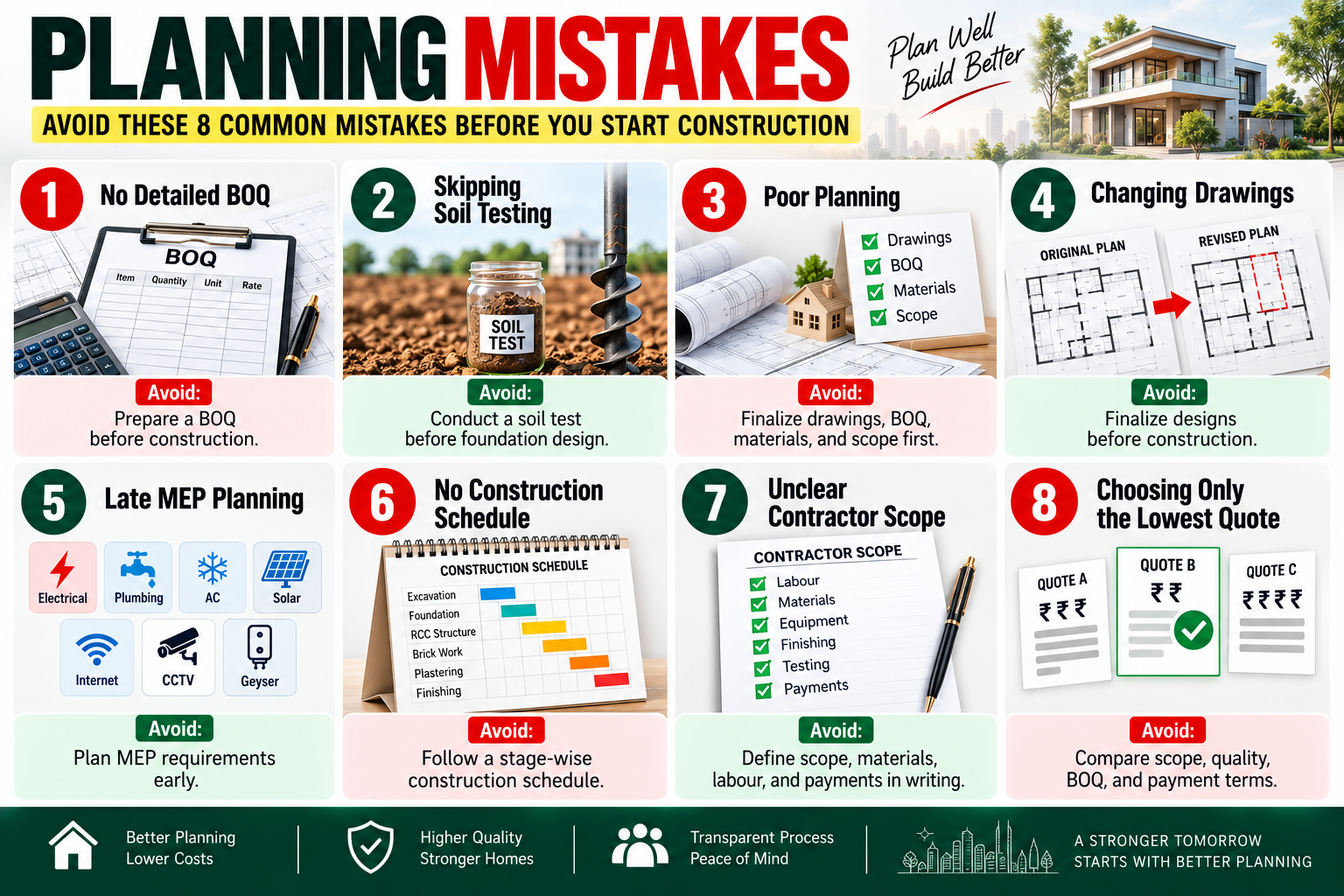
1. Starting Construction Without a Detailed BOQ
One of the most common mistakes is starting construction without a Bill of Quantities (BOQ).
A BOQ provides an estimated quantity and scope for major construction activities and materials.
Without a proper BOQ, homeowners may struggle to understand:
- How much material is required
- What the expected construction cost is
- Whether quantities are increasing
- Whether contractor bills are reasonable
- Where budget variations are occurring
How to avoid it
Prepare a detailed BOQ before starting construction and use it throughout the project for quantity monitoring, billing verification, and cost control.
2. Skipping the Soil Test
A soil test helps determine important soil characteristics for foundation design.
Skipping soil investigation can result in foundation decisions being made without adequate site-specific information.
How to avoid it
Conduct an appropriate soil investigation before finalizing the foundation design and provide the soil report to the structural engineer.
3. Poor Planning Before Construction
Starting excavation before finalizing drawings, specifications, material requirements, and contractor scope can create problems later.
How to avoid it
Finalize:
- Architectural drawings
- Structural drawings
- MEP drawings
- BOQ
- Material specifications
- Construction schedule
- Payment milestones
- Contractor scope
before major construction begins.
4. Changing Drawings During Construction
Frequent changes to room sizes, windows, electrical points, plumbing locations, or structural elements can increase cost and delay construction.
How to avoid it
Freeze the major design decisions before execution.
If a change becomes necessary, document it and assess its impact on cost, quantity, structural design, and timeline before implementing it.
5. Not Planning MEP Requirements Early
Electrical and plumbing requirements are sometimes considered only after civil works have progressed.
This can result in unnecessary cutting, chasing, rerouting, and rework.
How to avoid it
Coordinate:
- Electrical points
- Plumbing lines
- Drainage
- AC provisions
- Solar provisions
- Internet/network points
- CCTV
- Geyser points
- Kitchen requirements
before relevant construction stages begin.
6. Not Preparing a Construction Schedule
Without a schedule, homeowners may not know whether the project is progressing as planned.
How to avoid it
Create a stage-wise construction schedule covering:
- Site preparation
- Excavation
- Foundation
- Plinth
- RCC structure
- Brick/block work
- Plastering
- Waterproofing
- Flooring
- Painting
- Electrical and plumbing
- Doors and windows
- Final works
7. Not Defining the Contractor’s Scope
Verbal agreements can create disputes about what is included and excluded.
How to avoid it
Prepare a written scope covering:
- Labour
- Materials
- Equipment
- Transportation
- Scaffolding
- Wastage
- Finishing
- Cleaning
- Testing
- Rectification responsibilities
8. Choosing a Contractor Only Based on Price
The lowest quotation does not automatically mean the lowest final project cost.
A low initial quotation may exclude important items or use different specifications.
How to avoid it
Compare contractors based on:
- Scope
- Material specifications
- BOQ
- Labour inclusions
- Quality standards
- Timeline
- Payment terms
- Previous work
2. Structural Mistakes
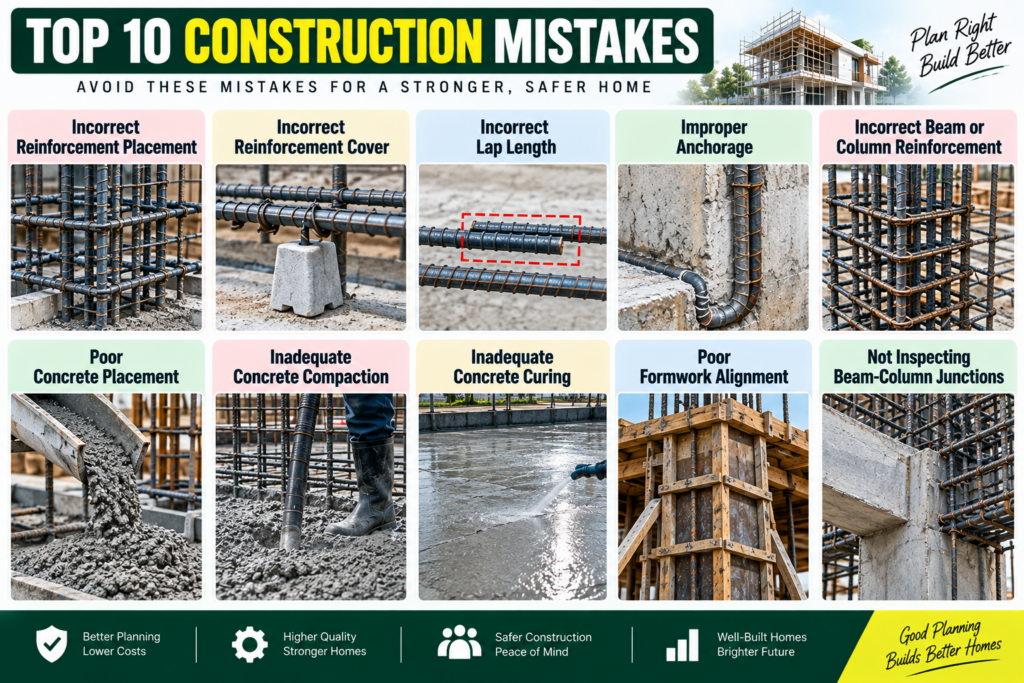
9. Incorrect Reinforcement Placement
Reinforcement must be placed according to the structural drawings.
Incorrect bar diameter, spacing, quantity, or positioning can affect structural performance.
How to avoid it
Conduct reinforcement inspections before concrete is poured.
10. Incorrect Reinforcement Cover
Concrete cover protects reinforcement from environmental exposure and contributes to durability.
Insufficient or inconsistent cover can create long-term durability problems.
How to avoid it
Verify the required cover based on the approved structural drawings and applicable standards.
Use proper concrete cover blocks rather than stones, broken tiles, wood pieces, or other unsuitable materials.
11. Incorrect Lap Length
Improper reinforcement lap lengths can compromise the intended continuity of reinforcement.
How to avoid it
Lap lengths and locations should follow the structural design and applicable code requirements.
Do not allow workers to decide reinforcement laps based only on site habit.
12. Improper Anchorage
Reinforcement must be properly anchored into structural members as required by the structural design.
How to avoid it
Check development and anchorage requirements before concrete placement.
13. Incorrect Beam or Column Reinforcement
Mistakes can occur in:
- Main bars
- Stirrups
- Tie spacing
- Bar diameter
- Bar positioning
- Beam-column junctions
How to avoid it
Carry out a pre-pour structural inspection for every major RCC element.
14. Poor Concrete Placement
Concrete should be placed properly to minimize segregation and ensure adequate compaction.
How to avoid it
Monitor:
- Concrete placement
- Pour sequence
- Workability
- Compaction
- Formwork condition
- Construction joints
15. Inadequate Concrete Compaction
Poor vibration can lead to honeycombing and voids.
How to avoid it
Use suitable mechanical vibration and ensure workers are trained in proper concrete placement and compaction.
16. Inadequate Concrete Curing
Concrete needs appropriate curing to develop its intended properties.
Insufficient curing can negatively affect durability and performance.
How to avoid it
Follow the curing requirements specified by the project engineer and applicable standards.
Maintain a curing record for critical RCC work where appropriate.
17. Poor Formwork Alignment
Improper shuttering can cause:
- Column misalignment
- Beam dimension variations
- Uneven surfaces
- Excessive deflection
- Leakage of cement slurry
How to avoid it
Inspect formwork for dimensions, alignment, level, stability, and cleanliness before concreting.
18. Not Inspecting Beam-Column Junctions
Beam-column junctions are important structural locations.
How to avoid it
Include beam-column junctions in the pre-pour inspection checklist and verify reinforcement according to approved structural drawings.
3. Material Mistakes
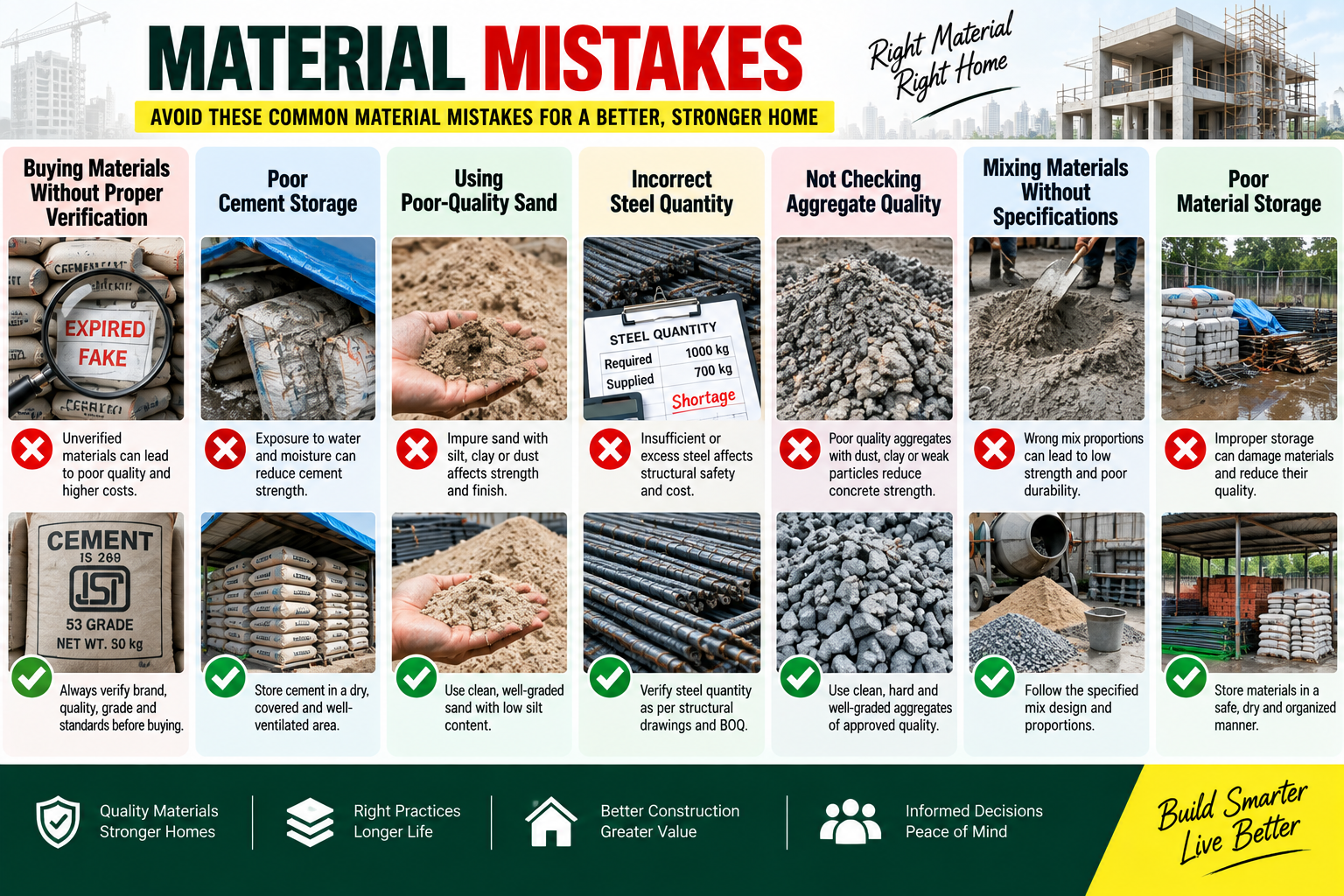
19. Buying Materials Without Proper Verification
Buying materials only because they are cheaper can create quality and cost-control problems.
How to avoid it
Verify:
- Brand
- Grade
- Quantity
- Specifications
- Test certificates where applicable
- Storage conditions
before accepting materials.
20. Poor Cement Storage
Cement exposed to moisture can deteriorate.
How to avoid it
Store cement in a dry, protected area and follow appropriate stacking and storage practices.
21. Using Poor-Quality Sand
Sand quality can affect mortar and concrete performance.
How to avoid it
Check the material for suitability and contamination and ensure it meets the project specifications.
22. Incorrect Steel Quantity
Ordering steel without proper quantity monitoring can lead to excess procurement, shortages, wastage, or cash-flow problems.
How to avoid it
Track steel consumption against the BOQ and structural requirements.
23. Not Checking Aggregate Quality
Aggregates should be suitable for the intended concrete application.
How to avoid it
Verify aggregate size, cleanliness, grading, and suitability according to project specifications.
24. Mixing Materials Without Specifications
Homeowners sometimes allow substitutions without understanding their technical impact.
How to avoid it
Maintain a material specification sheet covering approved materials, grades, brands, and applicable alternatives.
Any major substitution should be reviewed before use.
25. Poor Material Storage
Even good-quality materials can become damaged because of improper storage.
How to avoid it
Store:
- Cement away from moisture
- Steel away from unnecessary contamination and unsafe stacking
- Blocks/bricks appropriately
- Electrical materials in protected locations
- Plumbing materials away from physical damage
4. Contractor & Billing Mistakes
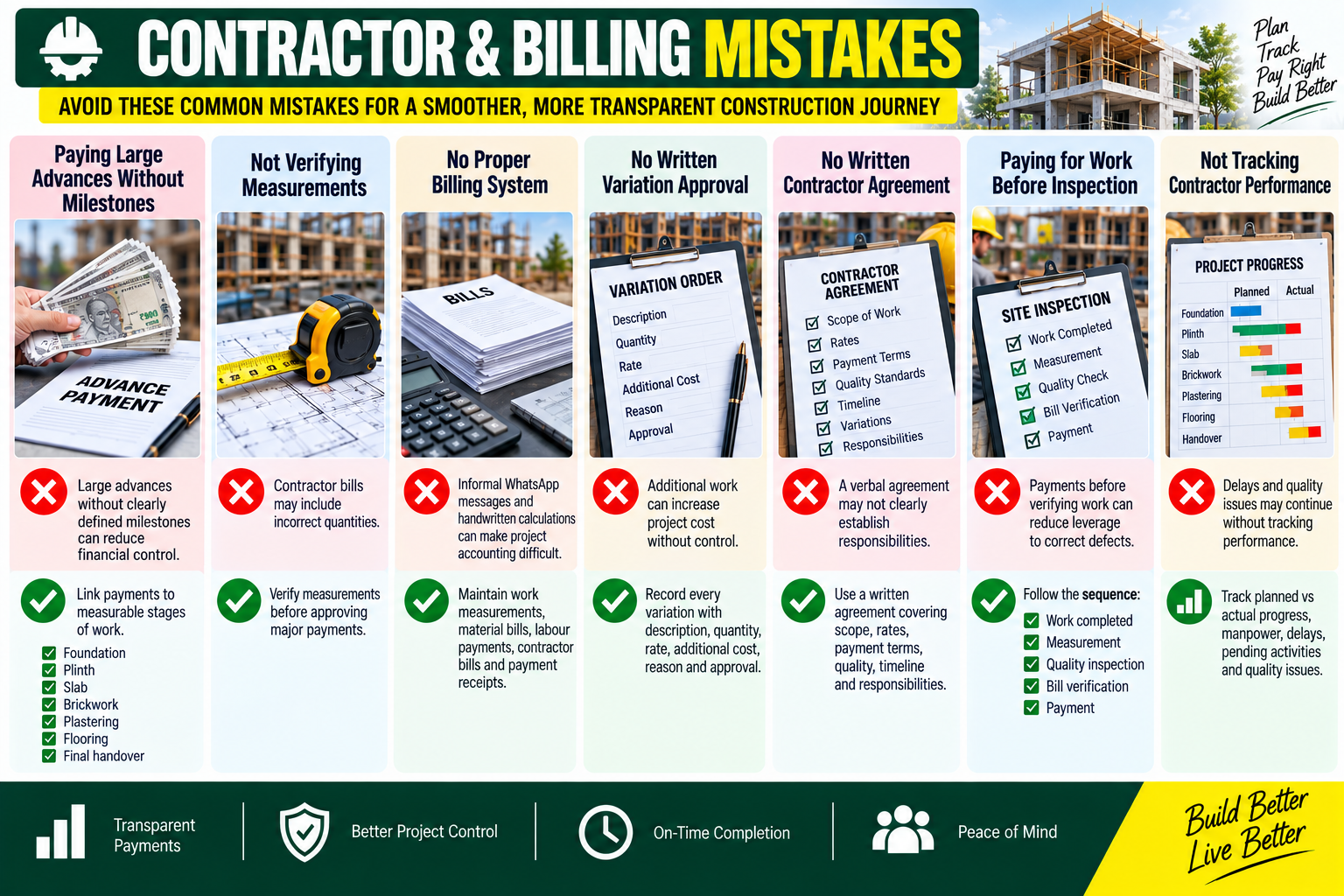
26. Paying Large Advances Without Milestones
Large advances without clearly defined milestones can reduce financial control.
How to avoid it
Link payments to measurable stages of work.
For example:
- Foundation completion
- Plinth completion
- Slab completion
- Brickwork completion
- Plastering completion
- Flooring completion
- Final handover
The exact payment structure should be agreed contractually.
27. Not Verifying Measurements
Contractor bills should be checked against actual executed quantities.
How to avoid it
Verify measurements before approving major payments.
28. No Proper Billing System
Informal WhatsApp messages and handwritten calculations can make project accounting difficult.
How to avoid it
Maintain:
- Work measurements
- Material bills
- Labour payments
- Contractor bills
- Payment receipts
- Variation records
29. No Written Variation Approval
Additional work can gradually increase the project cost.
How to avoid it
Record every variation with:
- Description
- Quantity
- Rate
- Additional cost
- Reason
- Approval
30. No Written Contractor Agreement
A verbal agreement may not clearly establish responsibilities.
How to avoid it
Use a written agreement covering scope, rates, payment terms, quality expectations, timeline, variations, and responsibilities.
31. Paying for Work Before Inspection
Payments made before verifying completed work can reduce the homeowner’s leverage to correct defects.
How to avoid it
Use the sequence:
Work completed → Measurement → Quality inspection → Bill verification → Payment
32. Not Tracking Contractor Performance
A project can have repeated delays without anyone documenting the cause.
How to avoid it
Track:
- Planned progress
- Actual progress
- Manpower
- Delays
- Pending activities
- Quality issues
- Rectification
5. Quality Control Mistakes
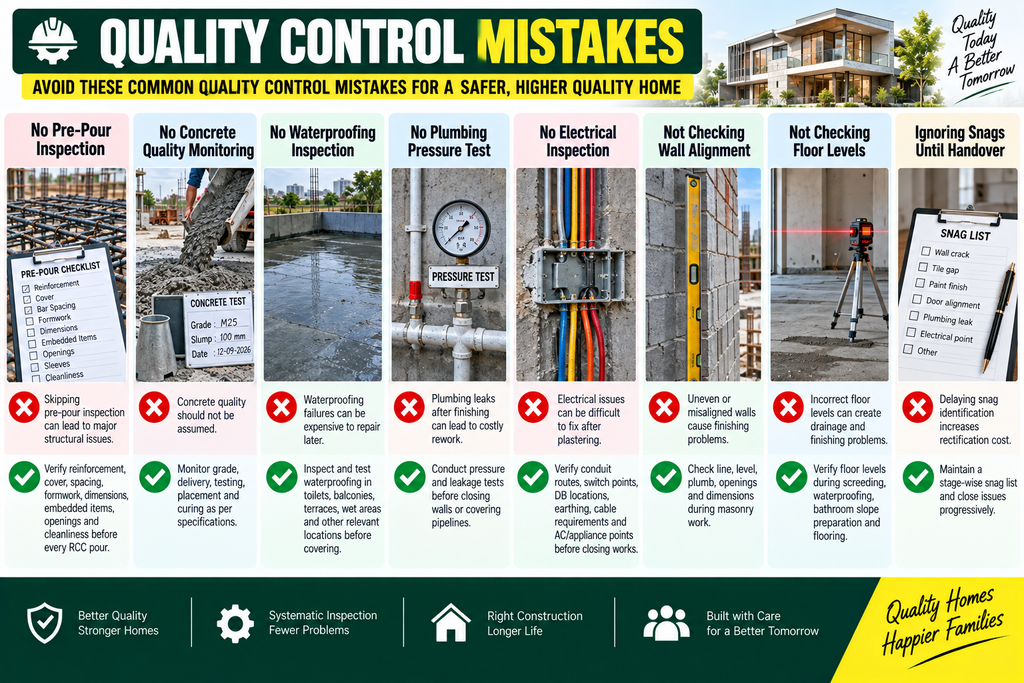
33. No Pre-Pour Inspection
One of the most important inspections is the inspection conducted before concrete placement.
How to avoid it
Before every major RCC pour, verify:
- Reinforcement
- Cover
- Bar spacing
- Formwork
- Dimensions
- Embedded items
- Openings
- Electrical sleeves
- Plumbing sleeves
- Cleanliness
34. No Concrete Quality Monitoring
Concrete quality should not be assumed simply because a concrete truck arrives at the site.
How to avoid it
Maintain appropriate records for concrete grade, delivery, workability/testing, placement, and curing as required by the project specifications.
35. No Waterproofing Inspection
Waterproofing failures can become expensive to repair after finishing work is completed.
How to avoid it
Inspect waterproofing at relevant areas such as:
- Toilets
- Balconies
- Terraces
- Wet areas
- Utility areas
- Basement areas where applicable
Testing should be completed before covering the waterproofed surface.
36. No Plumbing Pressure Test
Plumbing problems discovered after tiles and finishes are completed can result in expensive rework.
How to avoid it
Conduct appropriate pressure and leakage tests before closing walls or covering pipelines.
37. No Electrical Inspection
Electrical conduits and points can become difficult to modify after plastering.
How to avoid it
Verify:
- Conduit routes
- Switch points
- DB locations
- Earthing provisions
- Cable requirements
- AC points
- Appliance points
before closing the relevant works.
38. Not Checking Wall Alignment
Uneven or misaligned walls can create problems with plastering, tiling, wardrobes, doors, and furniture.
How to avoid it
Check line, level, plumb, openings, and dimensions during masonry work.
39. Not Checking Floor Levels
Incorrect floor levels can create drainage and finishing problems.
How to avoid it
Verify floor levels during screeding, waterproofing, bathroom slope preparation, and flooring.
40. Ignoring Snags Until Handover
Waiting until the end of construction to identify defects can increase rectification costs.
How to avoid it
Maintain a stage-wise snag list and close issues progressively.
6. Financial Mistakes
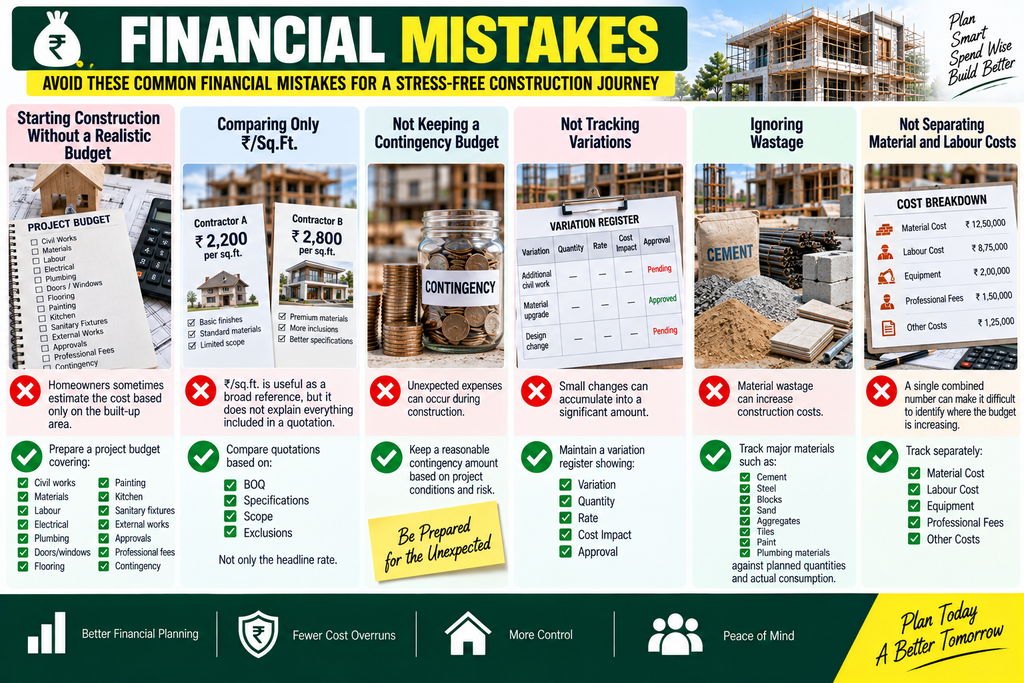
41. Starting Construction Without a Realistic Budget
Homeowners sometimes estimate the cost based only on the built-up area.
How to avoid it
Prepare a project budget covering:
- Civil works
- Materials
- Labour
- Electrical
- Plumbing
- Doors/windows
- Flooring
- Painting
- Kitchen
- Sanitary fixtures
- External works
- Approvals
- Professional fees
- Contingency
42. Comparing Only ₹/Sq.Ft.
₹/sq.ft. is useful as a broad reference, but it does not explain everything included in a construction quotation.
Two contractors quoting different rates may have completely different scopes and specifications.
How to avoid it
Compare quotations based on BOQ + specifications + scope + exclusions, not only the headline rate.
43. Not Keeping a Contingency Budget
Unexpected expenses can occur during construction.
How to avoid it
Keep a reasonable contingency amount based on project conditions and risk.
44. Not Tracking Variations
Small changes can accumulate into a significant amount.
How to avoid it
Maintain a variation register showing:
| Variation | Quantity | Rate | Cost Impact | Approval |
|---|---|---|---|---|
| Additional civil work | — | — | — | Pending/Approved |
| Material upgrade | — | — | — | Pending/Approved |
| Design change | — | — | — | Pending/Approved |
45. Ignoring Wastage
Material wastage can increase construction costs.
How to avoid it
Track major materials such as:
- Cement
- Steel
- Blocks
- Sand
- Aggregates
- Tiles
- Paint
- Plumbing materials
against planned quantities and actual consumption.
46. Not Separating Material and Labour Costs
A single combined number can make it difficult to identify where the budget is increasing.
How to avoid it
Track:
Material Cost + Labour Cost + Equipment + Professional Fees + Other Costs
separately.
7. Handover & Documentation Mistakes
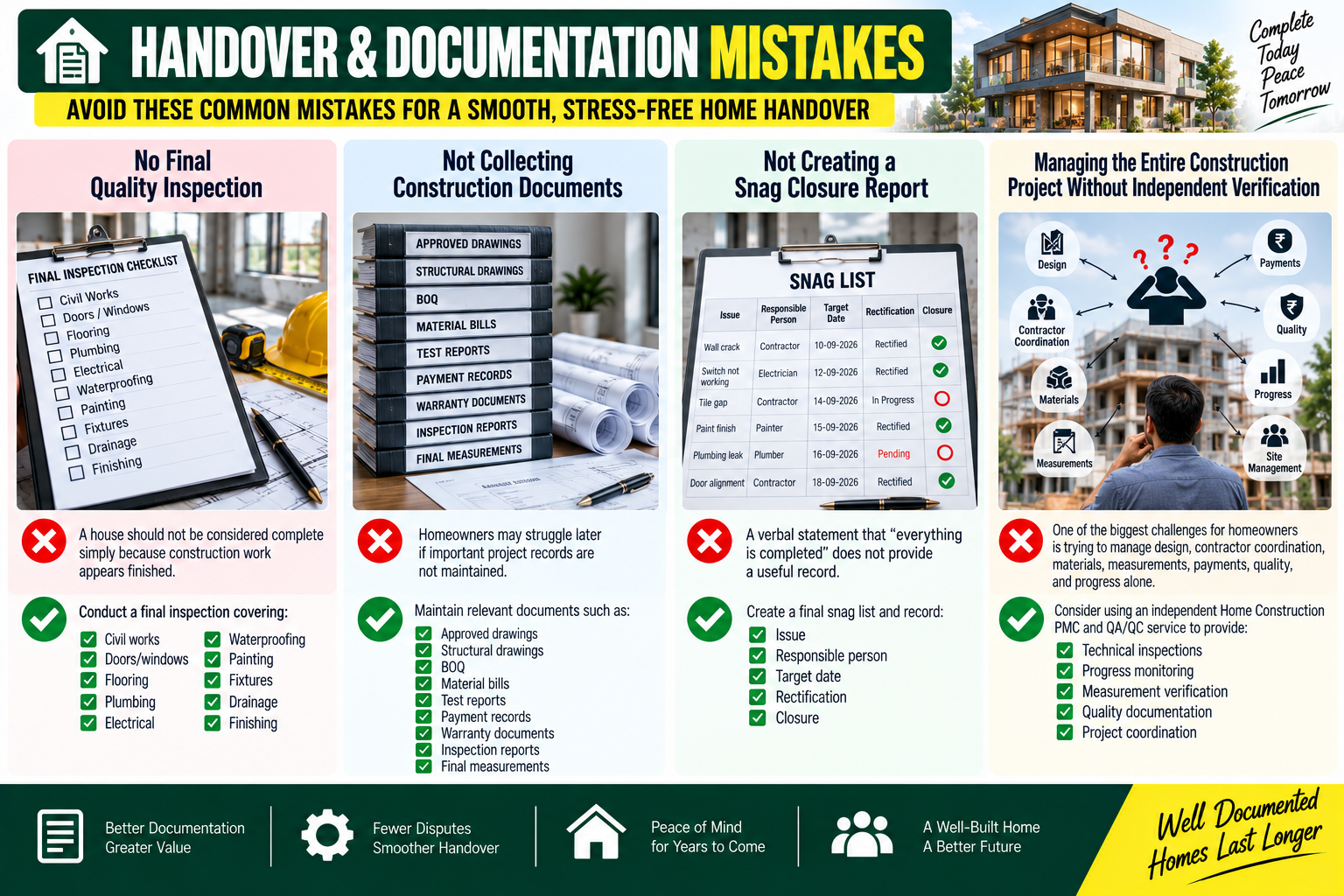
47. No Final Quality Inspection
A house should not be considered complete simply because construction work appears finished.
How to avoid it
Conduct a final inspection covering:
- Civil works
- Doors/windows
- Flooring
- Plumbing
- Electrical
- Waterproofing
- Painting
- Fixtures
- Drainage
- Finishing
48. Not Collecting Construction Documents
Homeowners may struggle later if important project records are not maintained.
How to avoid it
Maintain relevant documents such as:
- Approved drawings
- Structural drawings
- BOQ
- Material bills
- Test reports
- Payment records
- Warranty documents
- Inspection reports
- Final measurements
49. Not Creating a Snag Closure Report
A verbal statement that “everything is completed” does not provide a useful record.
How to avoid it
Create a final snag list and record:
Issue → Responsible person → Target date → Rectification → Closure
50. Managing the Entire Construction Project Without Independent Verification
One of the biggest challenges for homeowners is trying to manage design, contractor coordination, materials, measurements, payments, quality, and progress alone.
The contractor may be responsible for execution, but the homeowner still needs visibility into what is actually happening at the site.
How to avoid it
Consider using an independent Home Construction PMC and QA/QC service to provide technical inspections, progress monitoring, measurement verification, quality documentation, and project coordination.
Home Construction Quality Checklist
Before starting your house construction project in Hyderabad, make sure you have:
☐ Soil investigation where required
☐ Approved architectural drawings
☐ Structural drawings
☐ MEP drawings
☐ Detailed BOQ
☐ Material specifications
☐ Contractor agreement
☐ Construction schedule
☐ Payment milestones
☐ Measurement verification process
☐ Pre-pour inspection checklist
☐ Concrete quality monitoring
☐ Waterproofing inspection
☐ Plumbing testing
☐ Electrical inspection
☐ Stage-wise snag tracking
☐ Variation register
☐ Material tracking
☐ Payment documentation
☐ Final quality inspection
☐ Handover documentation
How QA/QC Can Help During Home Construction
Quality control should not start after a defect appears. It should be integrated into every important stage of construction.
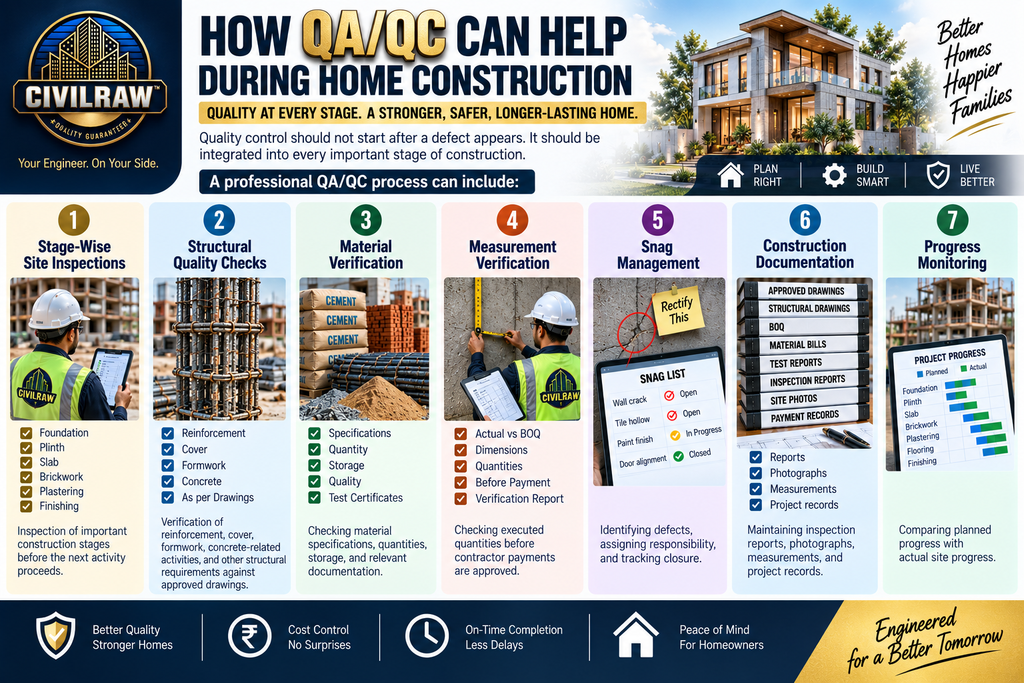
A professional QA/QC process can include:
1. Stage-Wise Site Inspections
Inspection of important construction stages before the next activity proceeds.
2. Structural Quality Checks
Verification of reinforcement, cover, formwork, concrete-related activities, and other structural requirements against approved drawings.
3. Material Verification
Checking material specifications, quantities, storage, and relevant documentation.
4. Measurement Verification
Checking executed quantities before contractor payments are approved.
5. Snag Management
Identifying defects, assigning responsibility, and tracking closure.
6. Construction Documentation
Maintaining inspection reports, photographs, measurements, and project records.
7. Progress Monitoring
Comparing planned progress with actual site progress.
Why Homeowners in Hyderabad Need Construction Monitoring
Hyderabad has a wide range of residential construction projects, from independent houses and duplex homes to large villas.
Construction involves multiple parties:
- Homeowner
- Architect
- Structural engineer
- Contractor
- Site engineer
- Labour teams
- Material suppliers
- Electrical contractors
- Plumbing contractors
- Interior contractors
Without proper coordination, communication gaps can lead to delays, variations, quality issues, and unexpected costs.
Independent project monitoring can give homeowners better visibility throughout the construction process.
CivilRaw — Home Construction PMC & QA/QC
CivilRaw provides Home Construction Project Management Consultancy (PMC) and QA/QC services for homeowners.
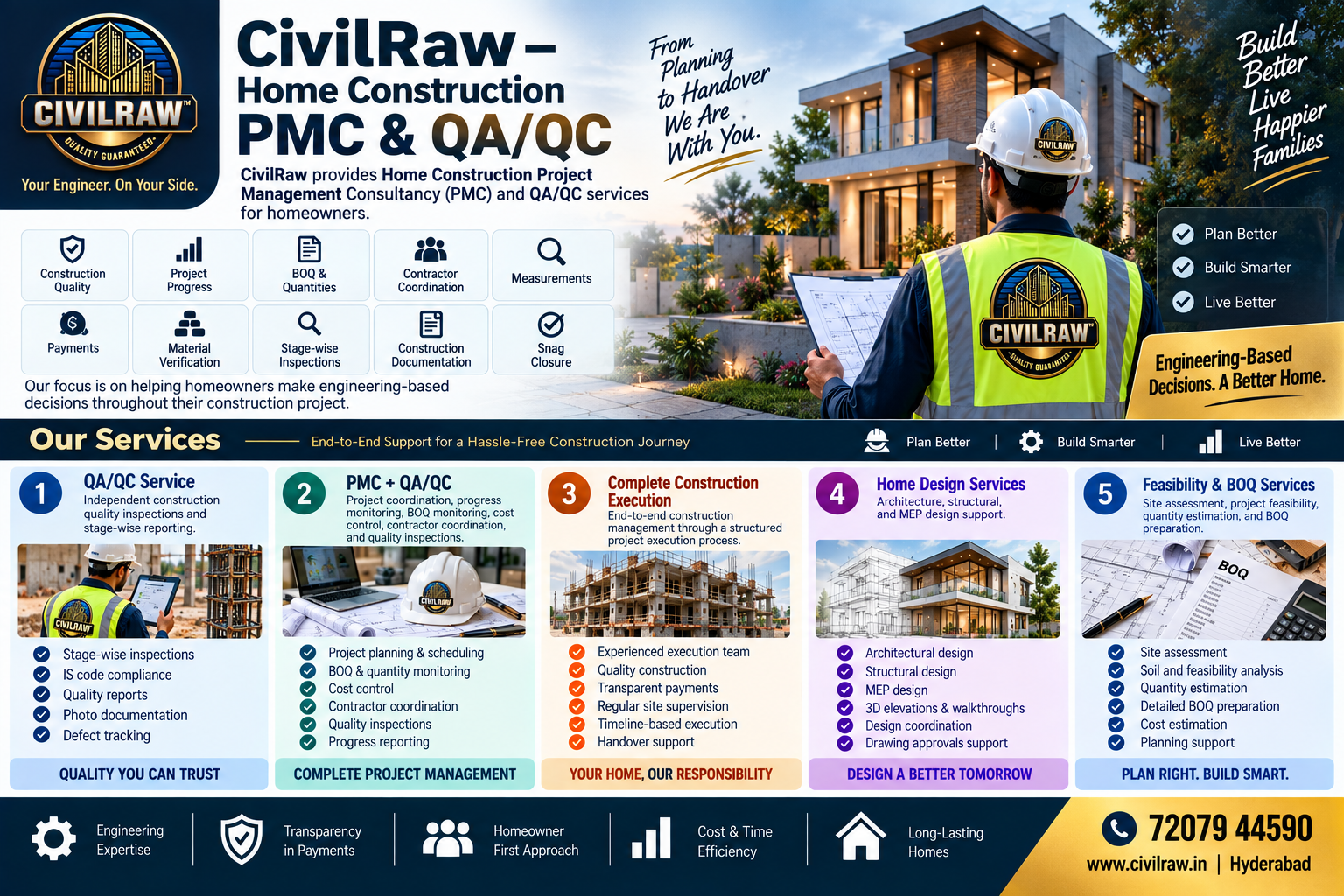
The focus is on helping homeowners monitor:
- Construction quality
- Project progress
- BOQ and quantities
- Contractor coordination
- Measurements
- Payments
- Material verification
- Stage-wise inspections
- Construction documentation
- Snag closure
CivilRaw’s approach is based on helping homeowners make engineering-based decisions throughout their construction project.
CivilRaw Services
QA/QC Service
Independent construction quality inspections and stage-wise reporting.
PMC + QA/QC
Project coordination, progress monitoring, BOQ monitoring, cost control, contractor coordination, and quality inspections.
Complete Construction Execution
End-to-end construction management through a structured project execution process.
Home Design Services
Architecture, structural, and MEP design support.
Feasibility & BOQ Services
Site assessment, project feasibility, quantity estimation, and BOQ preparation.
Final Thoughts
Building a home is not only about selecting a contractor and purchasing materials. It is a process involving planning, engineering, quality control, measurement, documentation, cost management, and continuous monitoring.
The earlier a construction mistake is identified, the easier it is generally to address.
Before starting your house construction in Hyderabad, make sure you have a clear BOQ, drawings, specifications, contractor scope, payment milestones, construction schedule, and quality inspection process.
If you are planning to build a house in Hyderabad, use this 50-point construction mistakes checklist as a reference throughout your project.
Build with planning. Verify with engineering. Monitor every stage.
Need help monitoring your home construction?
CivilRaw – Your Engineer. On Your Side.
For Home Construction PMC & QA/QC Services:
📞 7207944590
🌐 civilraw.in
✉️ contact@civilraw.in
Frequently Asked Questions
What are the most common house construction mistakes?
Common mistakes include starting without a BOQ, skipping soil investigation, changing drawings during construction, incorrect reinforcement placement, poor material storage, inadequate curing, lack of measurement verification, and making payments without proper milestone verification.
How can I control house construction costs in Hyderabad?
Start with a detailed BOQ, compare quotations based on scope and specifications, track material consumption, verify contractor measurements, document variations, and maintain a realistic contingency budget.
Is a BOQ necessary for house construction?
A detailed BOQ is highly useful for estimating quantities, comparing quotations, monitoring variations, checking contractor bills, and maintaining better cost visibility.
Why is pre-pour inspection important?
Pre-pour inspection allows the project team to verify reinforcement, cover, formwork, dimensions, sleeves, openings, and other requirements before concrete makes them difficult to inspect or correct.
Should homeowners hire an independent QA/QC engineer?
Independent QA/QC support can provide homeowners with additional technical verification of construction quality, measurements, materials, and stage-wise work, particularly when the homeowner does not have the time or technical expertise to monitor the project personally.
How often should a house construction site be inspected?
The appropriate inspection frequency depends on the project stage, scope, risk, and construction activity. Critical activities such as reinforcement and concrete works require inspection before they are covered or completed.
What should I check before paying a contractor?
Verify the completed work, measurements, agreed scope, quality, approved variations, previous payments, and supporting bills or records before releasing payment.
How can I avoid construction defects?
Use approved drawings, appropriate specifications, qualified professionals, stage-wise inspections, material verification, pre-pour checks, testing where required, and systematic snag tracking.
Related Topics
If you are planning construction in Hyderabad, you may also want to read:
- House Construction Cost in Hyderabad 2026
- House Construction Cost Per Sq.Ft. in Hyderabad
- Complete House Construction Checklist
- How to Prepare a BOQ for House Construction
- How to Select a House Construction Contractor
- PMC vs Contractor: What Is the Difference?
- QA/QC Checklist for Residential Construction
- 50 Things to Check Before Starting House Construction
- How to Control Construction Costs
- House Construction Timeline: Step-by-Step Guide
Primary SEO Keywords:
house construction mistakes in Hyderabad, construction mistakes to avoid, house construction checklist Hyderabad, home construction mistakes, house construction quality checklist, home construction PMC Hyderabad, QA QC for house construction, house construction cost Hyderabad, construction quality control Hyderabad, independent construction inspection Hyderabad.
Suggested URL Slug:/50-house-construction-mistakes-hyderabad/
Suggested Meta Title:
50 House Construction Mistakes in Hyderabad & How to Avoid Them
Suggested Meta Description:
Discover 50 common house construction mistakes homeowners make in Hyderabad. Learn how to avoid structural, material, contractor, quality and financial mistakes.
Planning Your Construction?
Don't rely on guesswork. Get a transparent, engineer-backed estimate for your home.
Get Cost Estimate