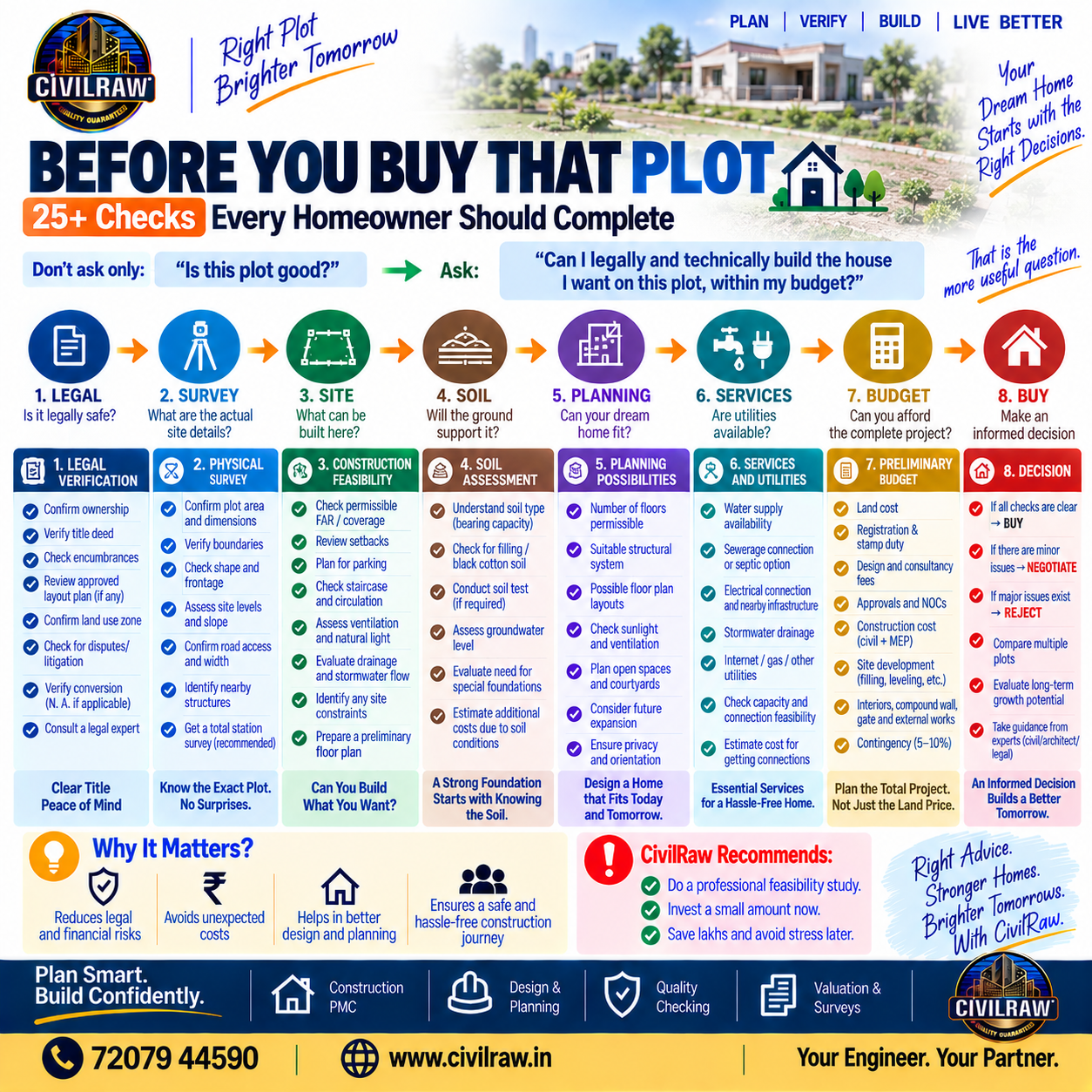
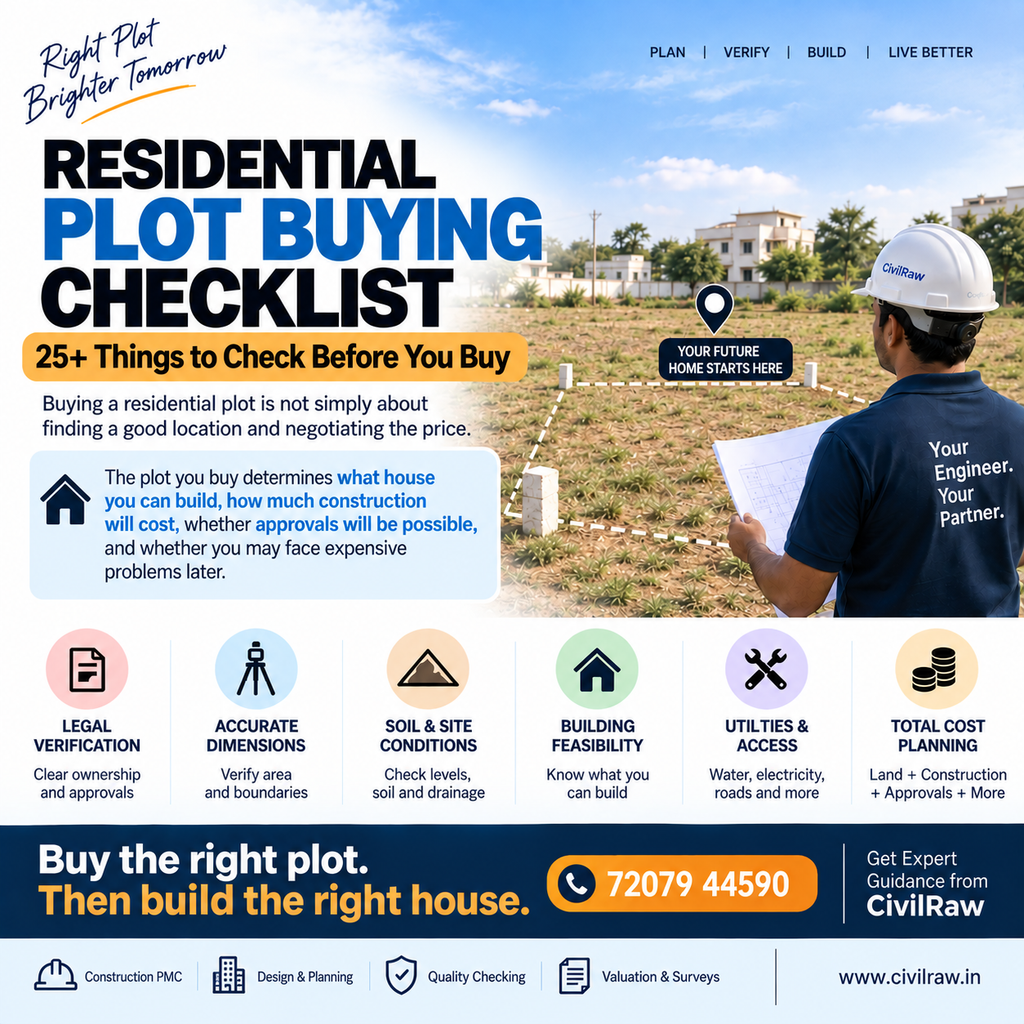
🏠 Residential Plot Buying Checklist: 25+ Things to Check Before You Buy
Buying a residential plot is not simply about finding a good location and negotiating the price.
The plot you buy determines what house you can build, how much construction will cost, whether approvals will be possible, and whether you may face expensive problems later.
A plot may look attractive from the road but still have problems such as:
- Incorrect dimensions
- Boundary disputes
- Poor road access
- Low-lying ground
- Weak soil
- Drainage problems
- Encroachments
- Restrictions on construction
- Unclear ownership
- Unapproved layout
- Poor setbacks
- Utility issues
- Land-use restrictions
Therefore, before paying a token advance or signing the sale agreement, the plot should be checked from three perspectives:
LEGAL + TECHNICAL + CONSTRUCTION FEASIBILITY
1. Verify the Exact Plot Dimensions
Never depend only on the dimensions mentioned by the seller.
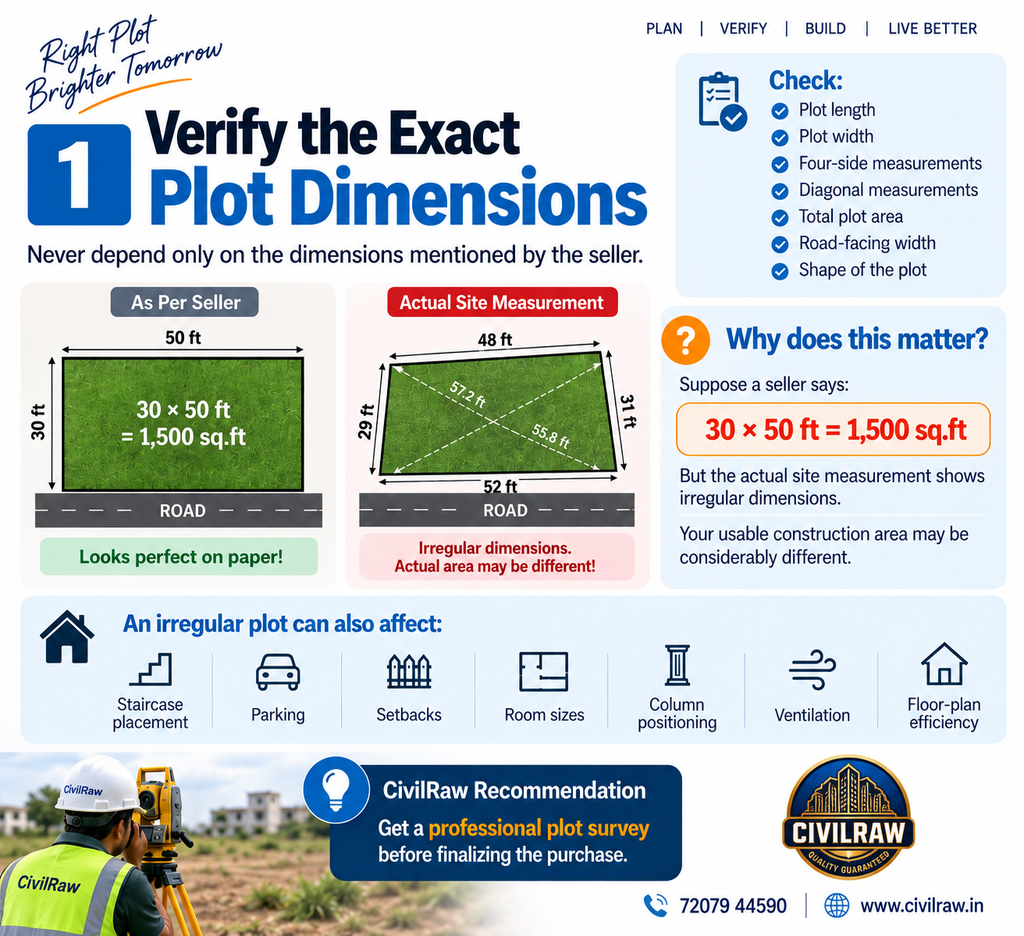
Check:
- Plot length
- Plot width
- Four-side measurements
- Diagonal measurements
- Total plot area
- Road-facing width
- Shape of the plot
Why does this matter?
Suppose a seller says:
30 × 50 ft = 1,500 sq.ft
But the actual site measurement shows irregular dimensions.
Your usable construction area may be considerably different.
An irregular plot can also affect:
- Staircase placement
- Parking
- Setbacks
- Room sizes
- Column positioning
- Ventilation
- Floor-plan efficiency
CivilRaw Recommendation
Get a professional plot survey before finalizing the purchase.
2. Confirm the Plot Area With a Survey
The area mentioned in the sale documents and the physical area on site should be compared.
For example:
| Particular | Value |
|---|---|
| Documented area | 1,500 sq.ft |
| Seller’s measurement | 1,500 sq.ft |
| Physical survey | 1,460 sq.ft |
| Difference | 40 sq.ft |
Even a small difference can become significant when land prices are high.
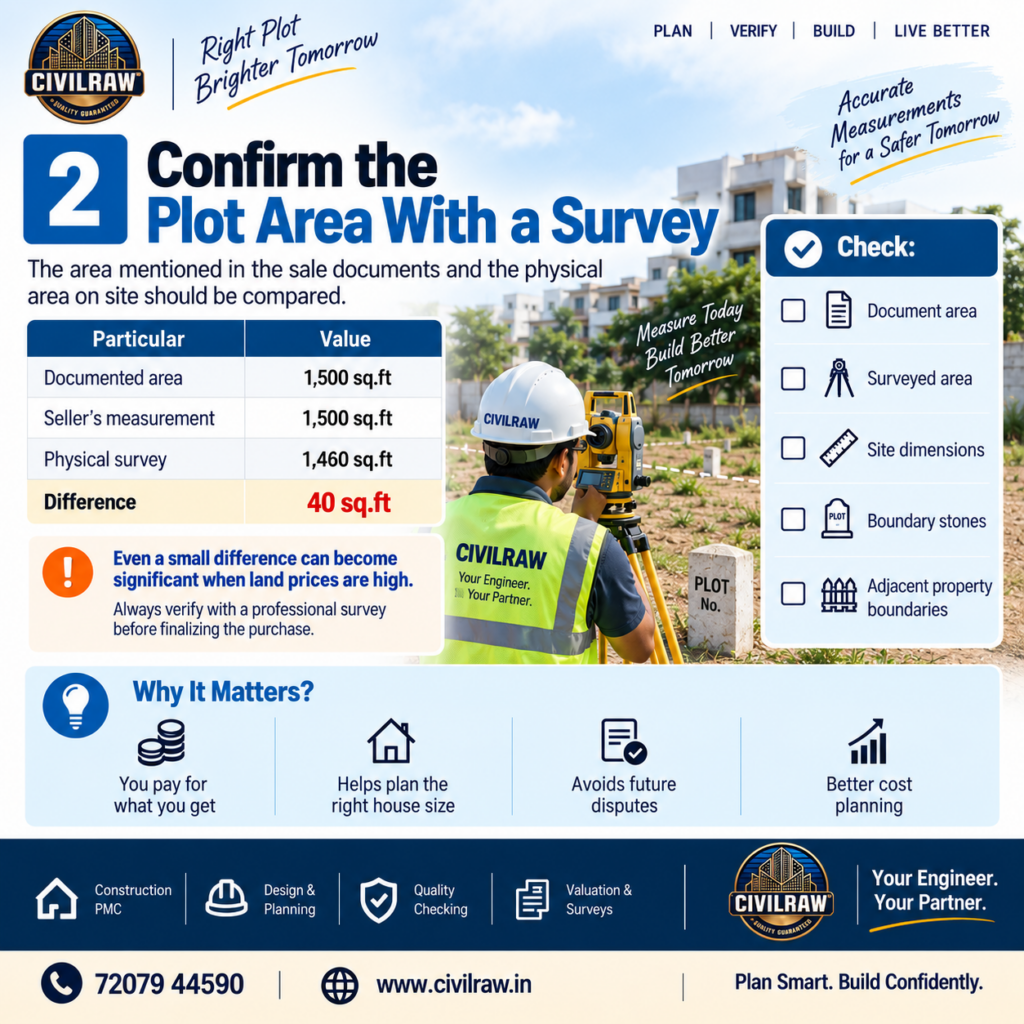
Check:
☐ Document area
☐ Surveyed area
☐ Site dimensions
☐ Boundary stones
☐ Adjacent property boundaries
3. Check the Road Width
Road width is one of the most important construction considerations.
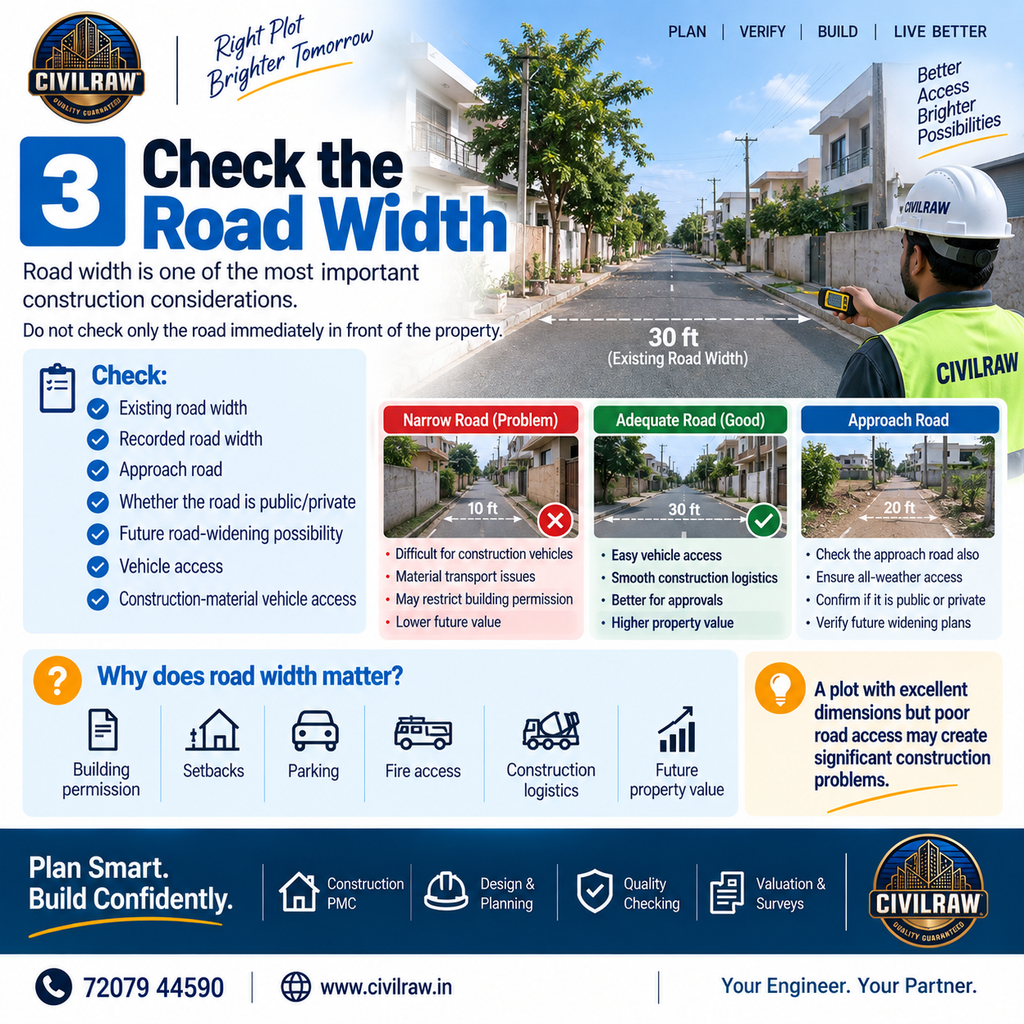
Do not check only the road immediately in front of the property.
Check:
- Existing road width
- Recorded road width
- Approach road
- Whether the road is public/private
- Future road-widening possibility
- Vehicle access
- Construction-material vehicle access
Why does road width matter?
It can affect:
- Building permission
- Setbacks
- Parking
- Fire access
- Construction logistics
- Future property value
A plot with excellent dimensions but poor road access may create significant construction problems.
4. Check Road Level vs Plot Level
This is a commonly ignored construction issue.
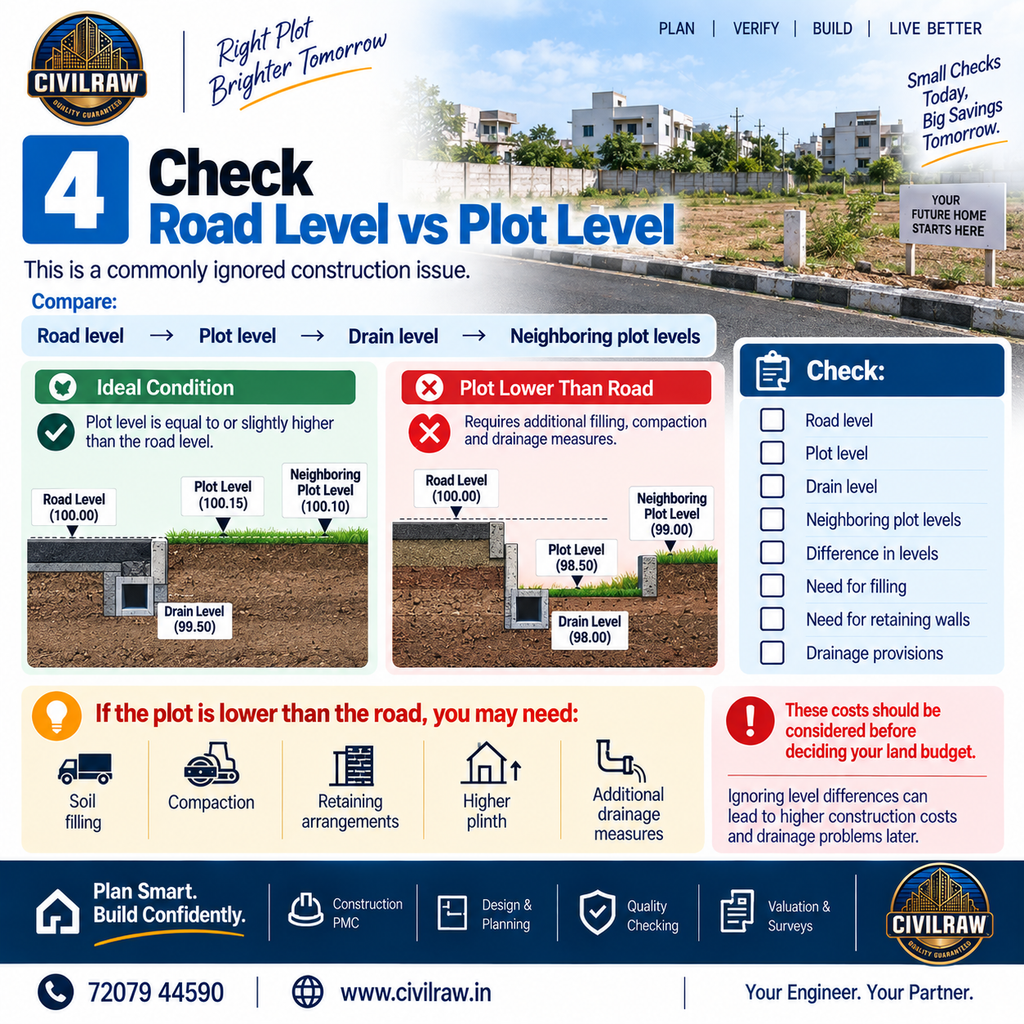
Compare:
Road level → Plot level → Drain level → Neighboring plot levels
If the plot is considerably lower than the road, you may need:
- Soil filling
- Compaction
- Retaining arrangements
- Higher plinth
- Additional drainage measures
These costs should be considered before deciding your land budget.
5. Check Whether the Plot Is Low-Lying
Visit the property after rainfall if possible.
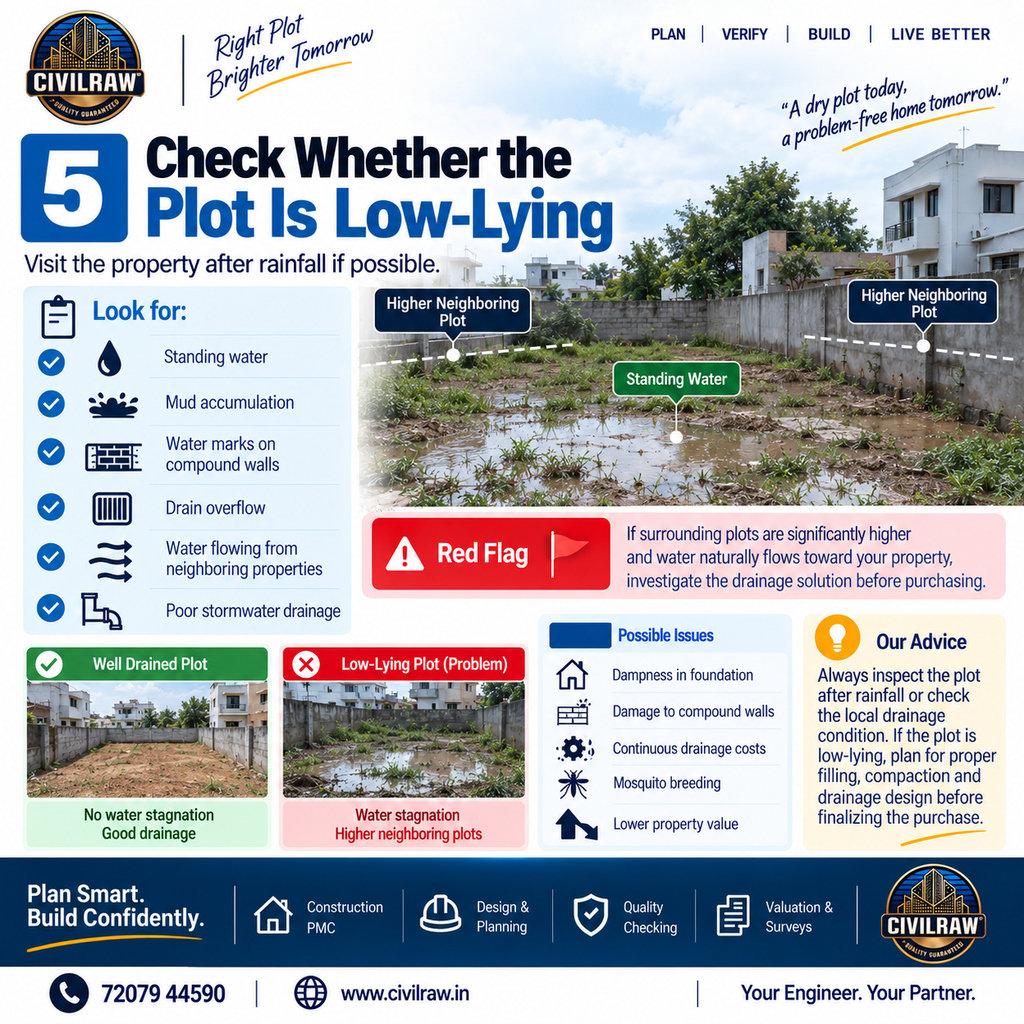
Look for:
- Standing water
- Mud accumulation
- Water marks on compound walls
- Drain overflow
- Water flowing from neighboring properties
- Poor stormwater drainage
Red flag 🚩
If surrounding plots are significantly higher and water naturally flows toward your property, investigate the drainage solution before purchasing.
6. Check Soil Conditions
The soil underneath the plot will eventually carry your house.
A visually attractive plot does not necessarily mean good foundation conditions.
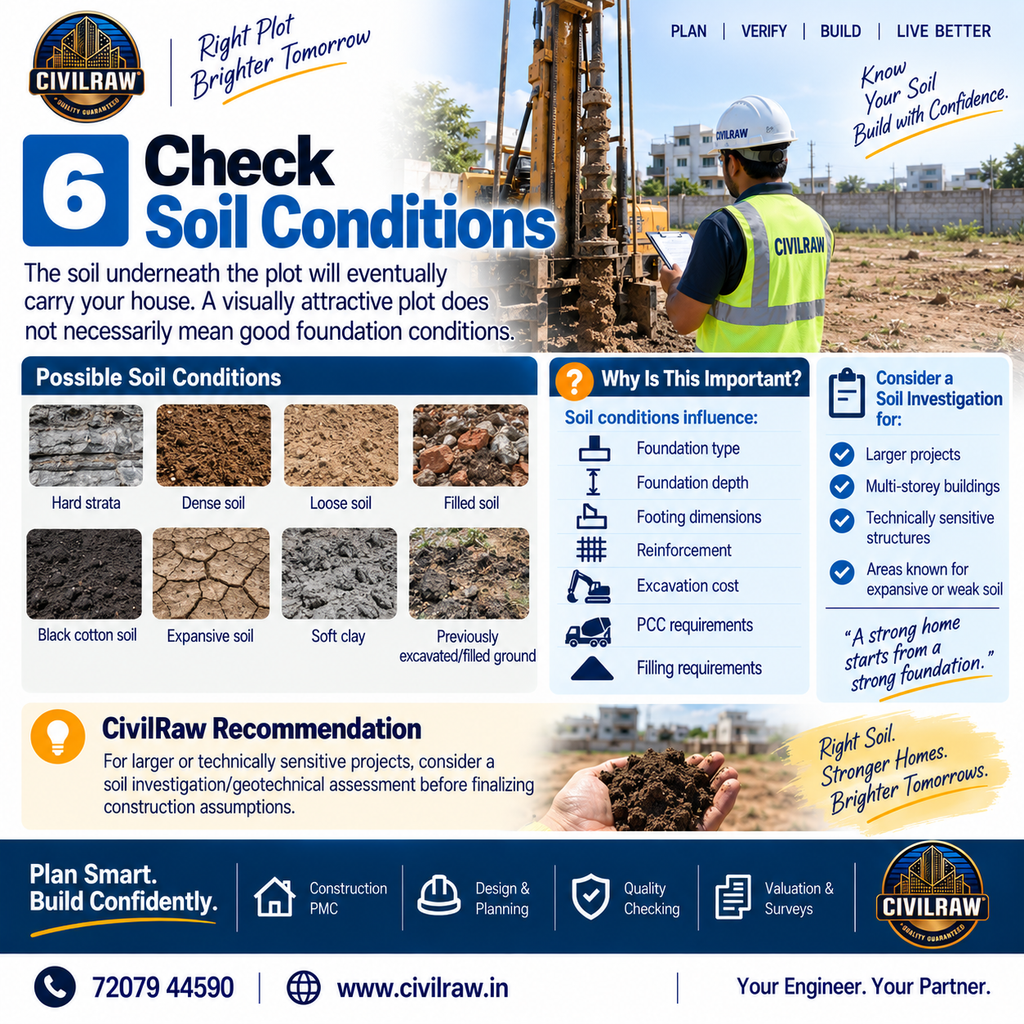
Possible soil conditions include:
- Hard strata
- Dense soil
- Loose soil
- Filled soil
- Black cotton soil
- Expansive soil
- Soft clay
- Previously excavated/filled ground
Why is this important?
Soil conditions influence:
- Foundation type
- Foundation depth
- Footing dimensions
- Reinforcement
- Excavation cost
- PCC requirements
- Filling requirements
For larger or technically sensitive projects, consider a soil investigation/geotechnical assessment before finalizing construction assumptions.
7. Check Whether the Land Has Been Filled
Ask:
“Was this land naturally at this level, or was soil brought and filled here?”
Filled land requires additional investigation.
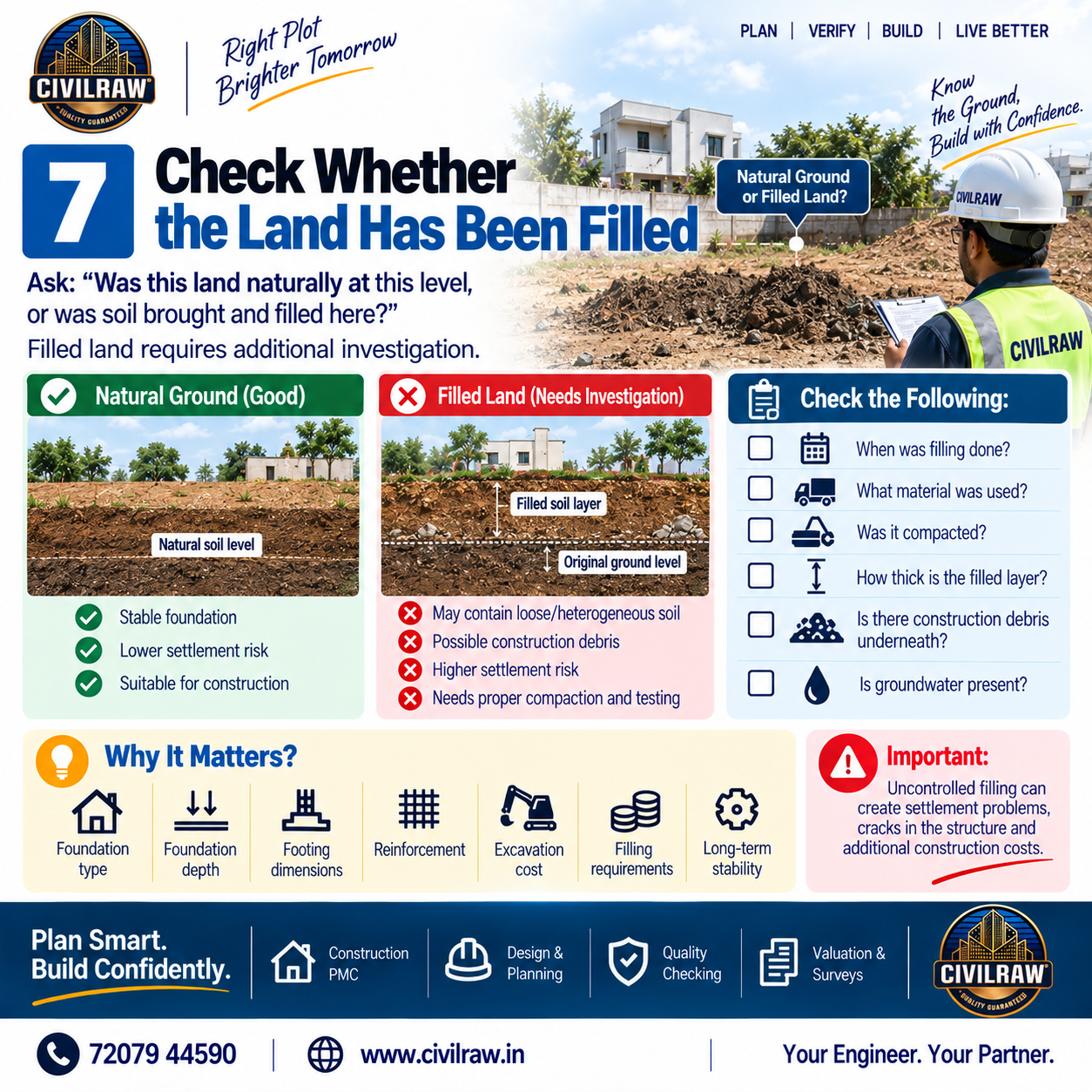
Check:
☐ When was filling done?
☐ What material was used?
☐ Was it compacted?
☐ How thick is the filled layer?
☐ Is there construction debris underneath?
☐ Is groundwater present?
Uncontrolled filling can create settlement problems.
8. Verify Plot Boundaries
Physically identify all four boundaries.
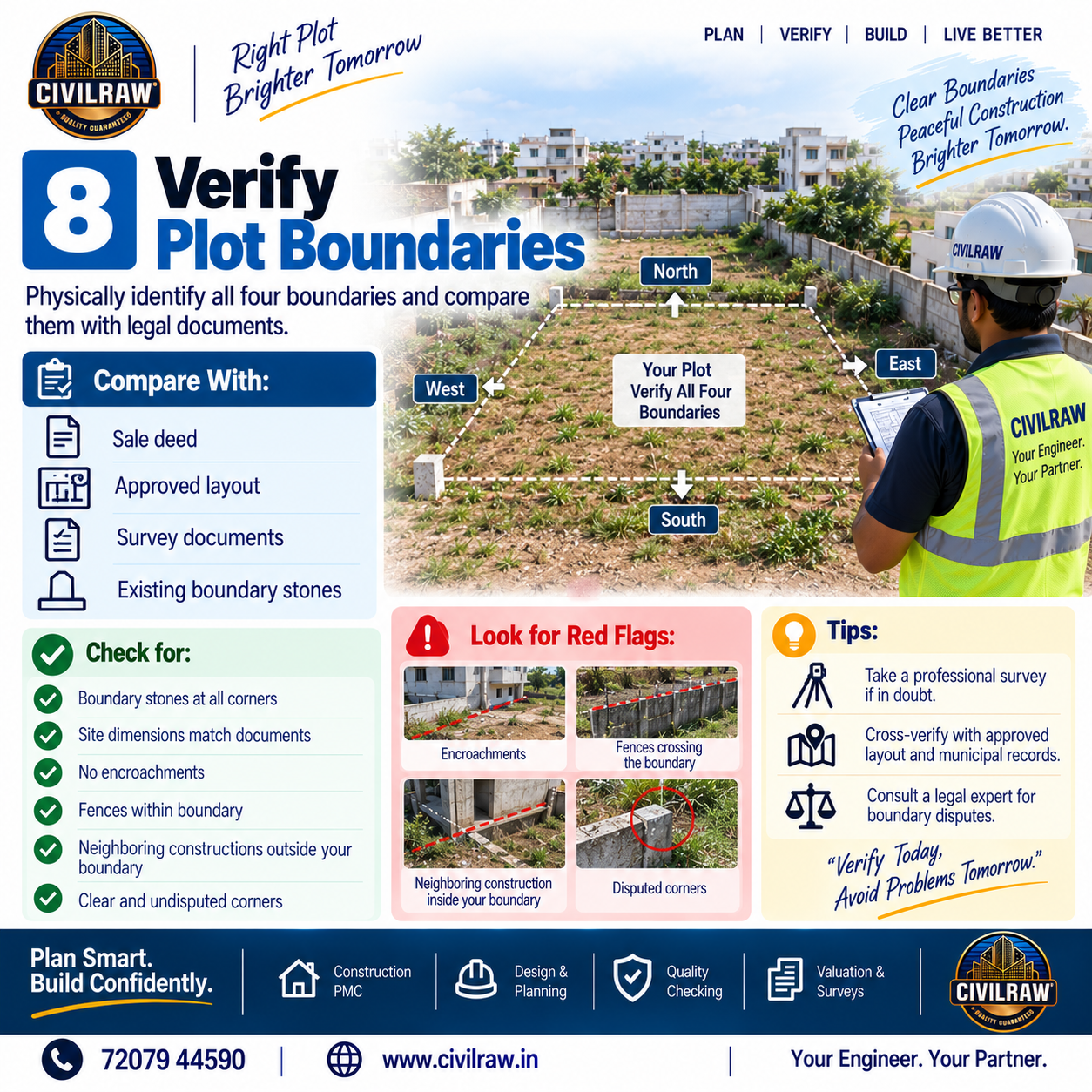
Check:
- North
- South
- East
- West
Compare the physical boundaries with:
- Sale deed
- Approved layout
- Survey documents
- Existing boundary stones
Look for:
🚩 Encroachments
🚩 Fences crossing the boundary
🚩 Neighboring construction inside your boundary
🚩 Disputed corners
9. Check the Shape of the Plot
A rectangular plot is generally easier to plan.
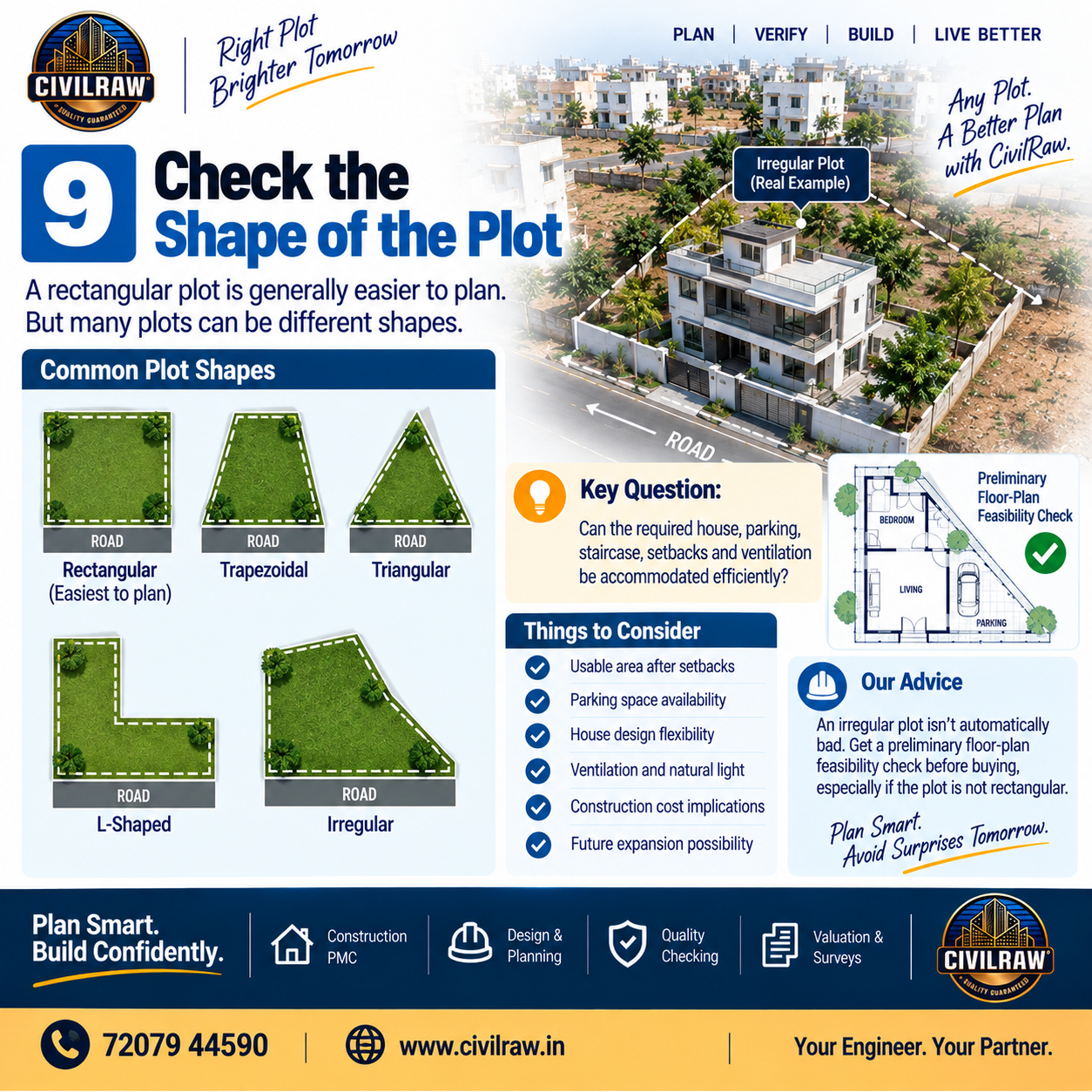
But many plots are:
- Trapezoidal
- Triangular
- L-shaped
- Irregular
An irregular plot isn’t automatically bad.
The important question is:
Can the required house, parking, staircase, setbacks and ventilation be accommodated efficiently?
Get a preliminary floor-plan feasibility check before buying if the plot is irregular.
10. Check Setback Requirements
Before purchasing, understand how much land may actually be available for construction after mandatory setbacks.
Your gross plot area is not necessarily your buildable footprint.
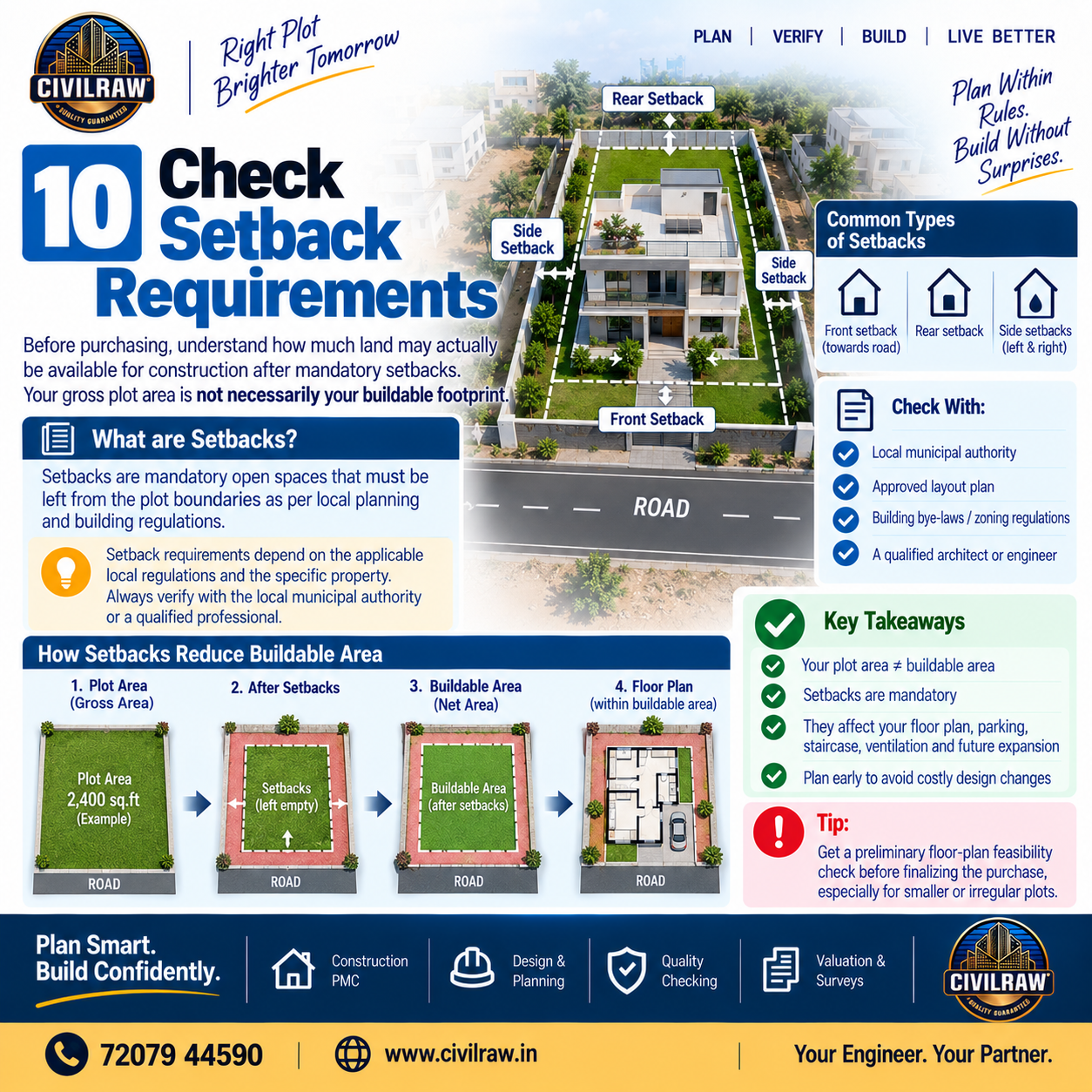
Conceptually:
Plot Area → Setbacks → Buildable Area → Floor Plan → Structural Design
Setback requirements depend on applicable local planning/building regulations and the specific property.
11. Check Your Intended Number of Floors
Don’t buy a plot assuming:
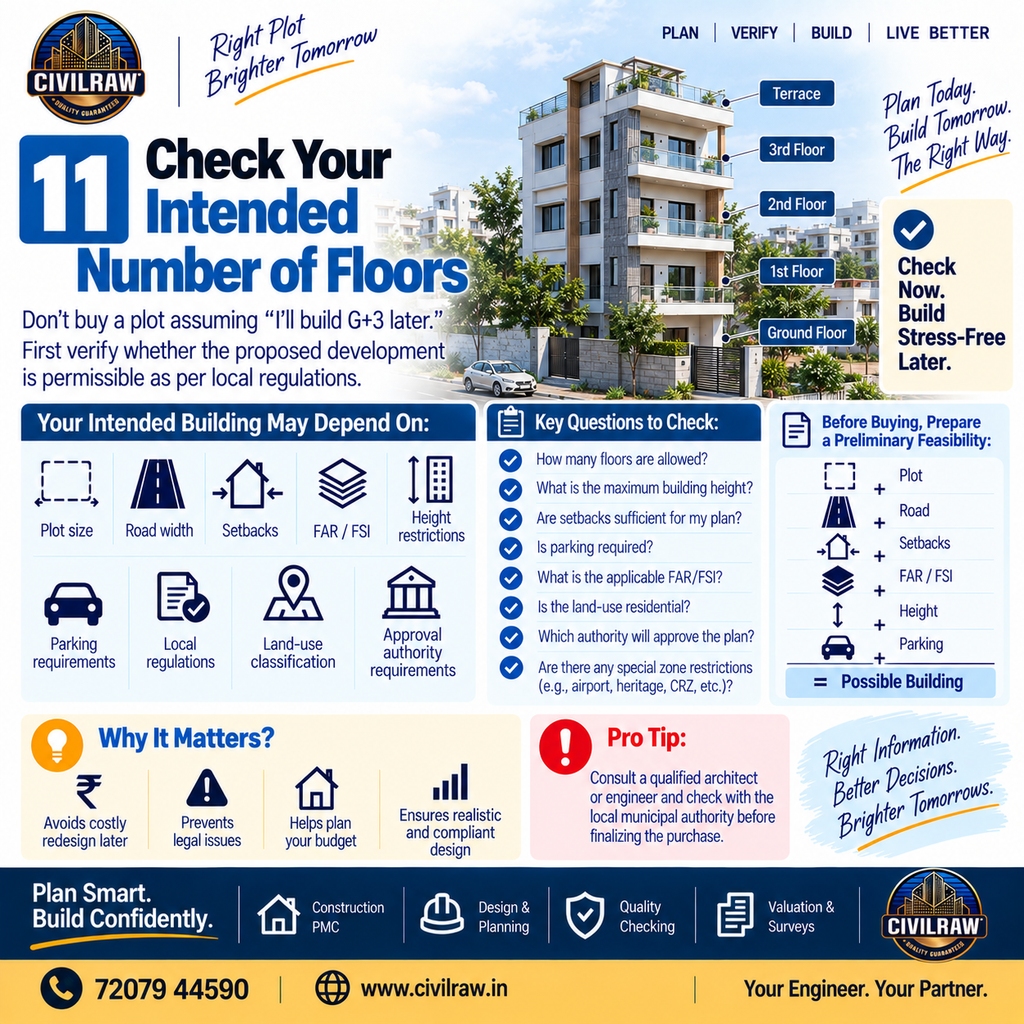
“I’ll build G+3 later.”
First verify whether the proposed development is permissible.
Your intended building may depend on:
- Plot size
- Road width
- Local regulations
- Setbacks
- Height restrictions
- Parking requirements
- Land-use classification
- Approval authority requirements
Before buying:
Prepare a preliminary feasibility:
Plot + Road + Setbacks + FAR/FSI + Height + Parking = Possible Building
12. Check the Land Use
Confirm that the property can legally be used for the intended purpose.
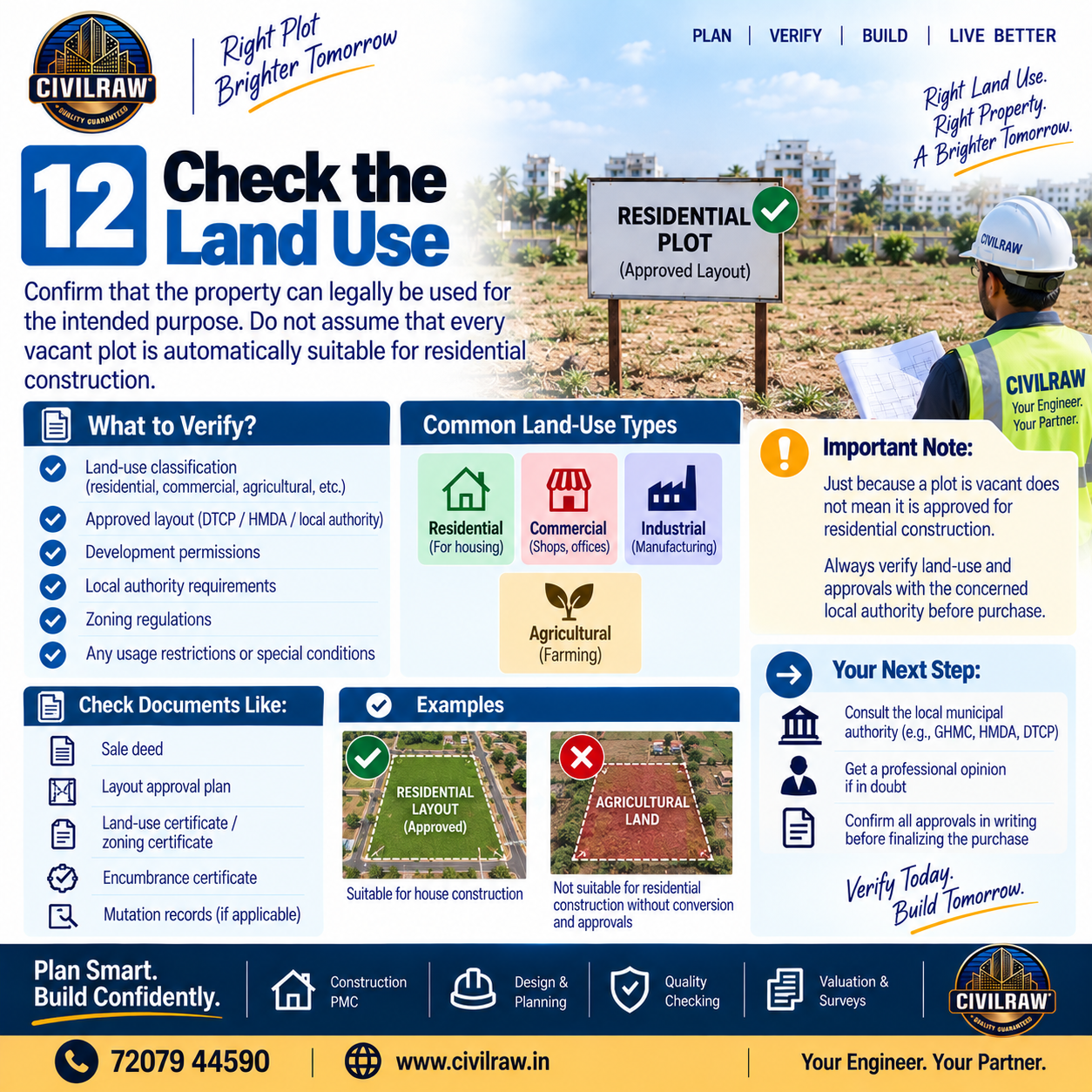
For a house, verify applicable:
- Land-use classification
- Layout approval
- Development permissions
- Local authority requirements
Do not assume that every vacant plot is automatically suitable for residential construction.
13. Verify Layout Approval
If the plot is part of a plotted development/layout, verify the relevant approval documents.
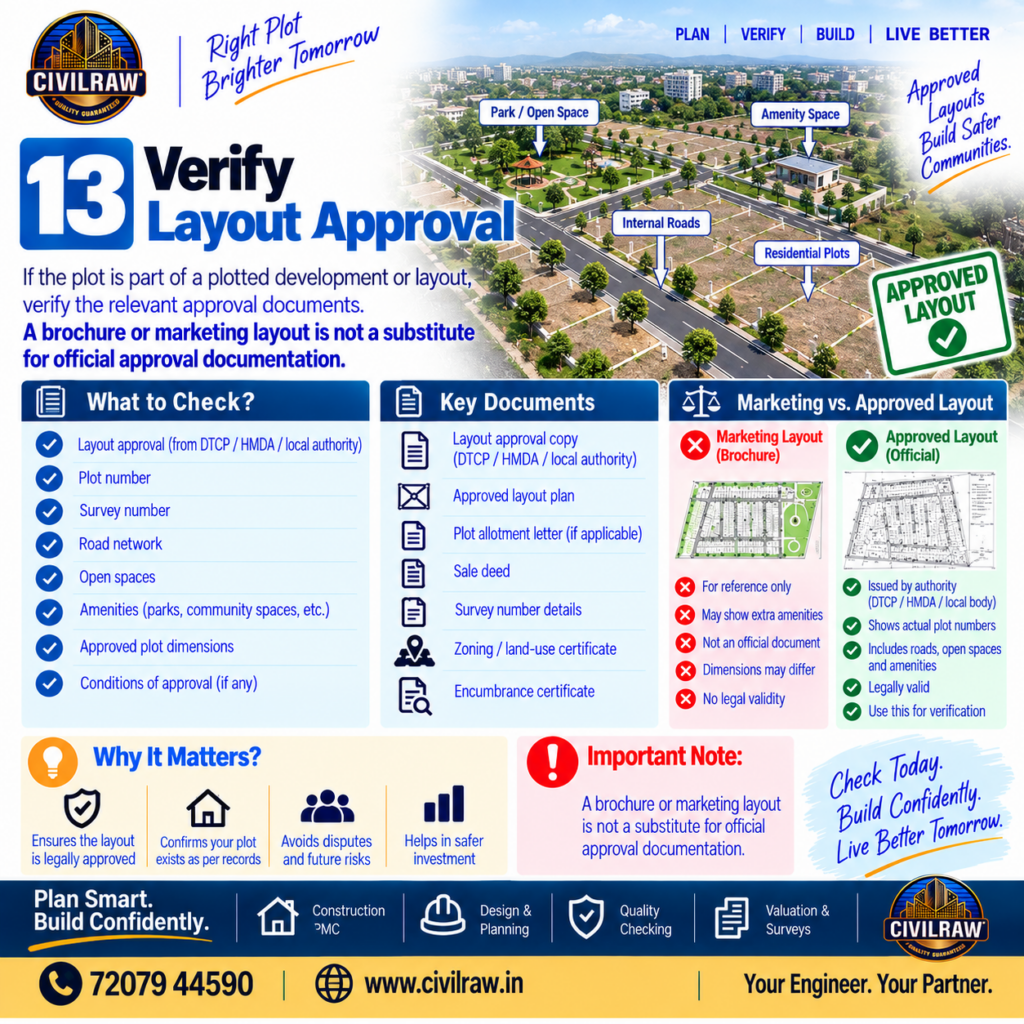
Check:
☐ Layout approval
☐ Plot number
☐ Survey number
☐ Road network
☐ Open spaces
☐ Amenities
☐ Approved plot dimensions
A brochure or marketing layout is not a substitute for official approval documentation.
14. Verify Ownership and Title
This is a legal verification and should be handled by a qualified property lawyer/document professional.
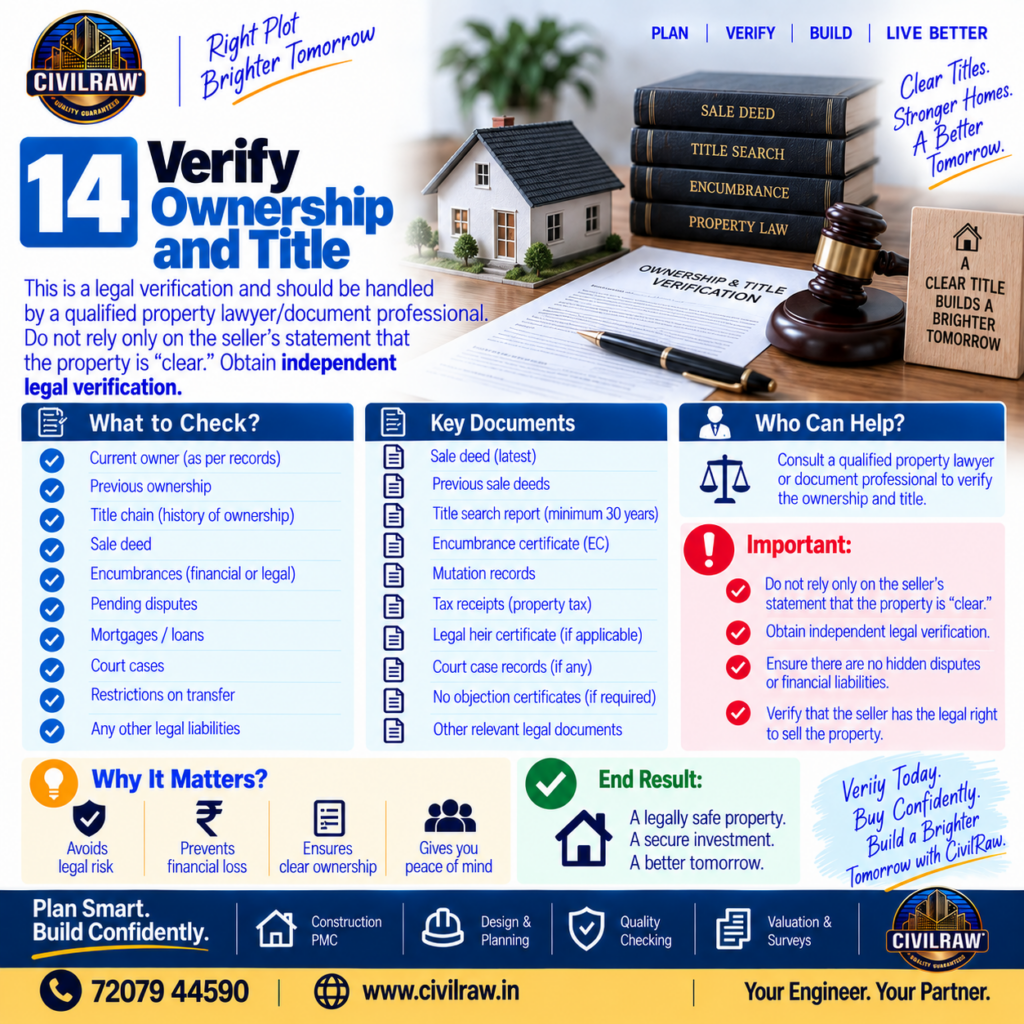
Check:
- Current owner
- Previous ownership
- Title chain
- Sale deed
- Encumbrances
- Pending disputes
- Mortgages/loans
- Court cases
- Restrictions on transfer
Important
Do not rely only on the seller’s statement that the property is “clear.”
Obtain independent legal verification.
15. Verify Survey Number and Land Records
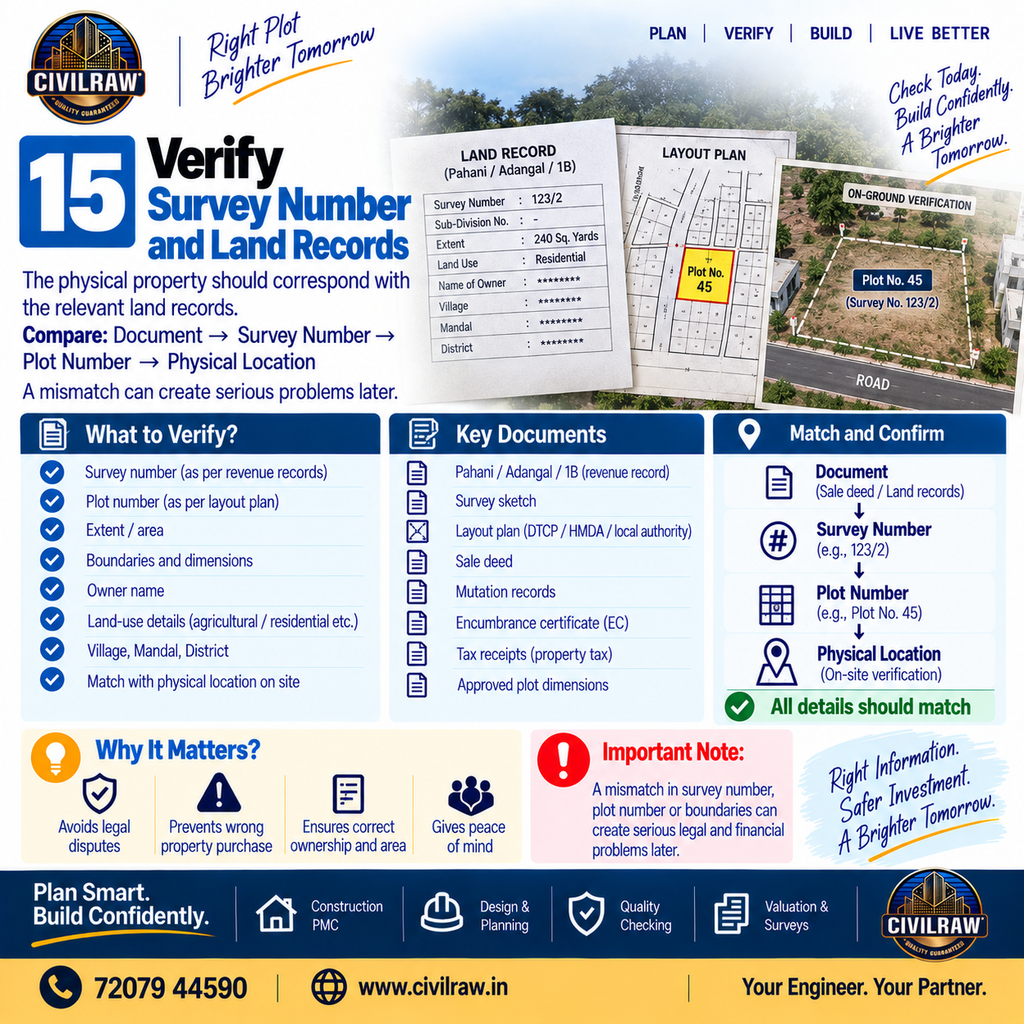
The physical property should correspond with the relevant land records.
Compare:
Document → Survey Number → Plot Number → Physical Location
A mismatch can create serious problems later.
16. Check Encumbrance
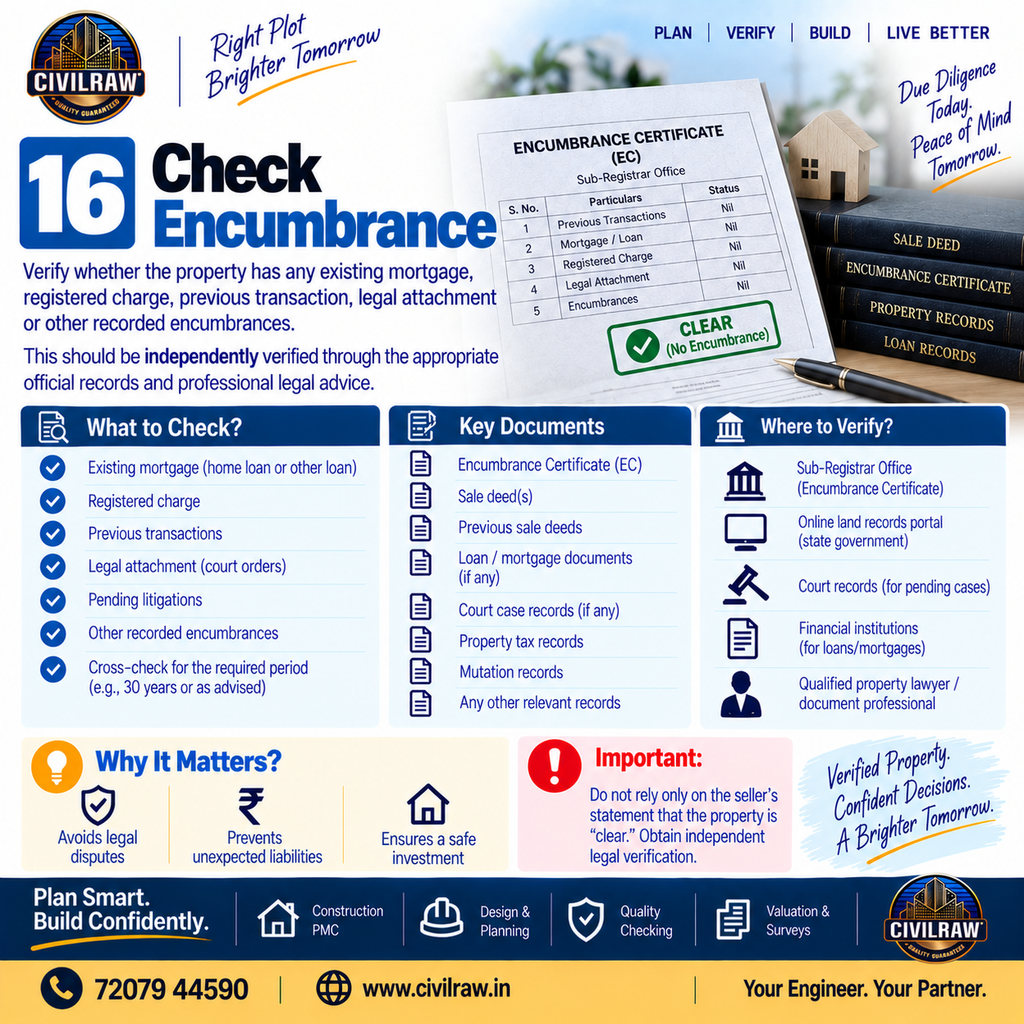
Verify whether the property has:
- Existing mortgage
- Registered charge
- Previous transaction
- Legal attachment
- Other recorded encumbrances
This should be independently verified through the appropriate official records and professional legal advice.
17. Check Existing Structures
If there is an old:
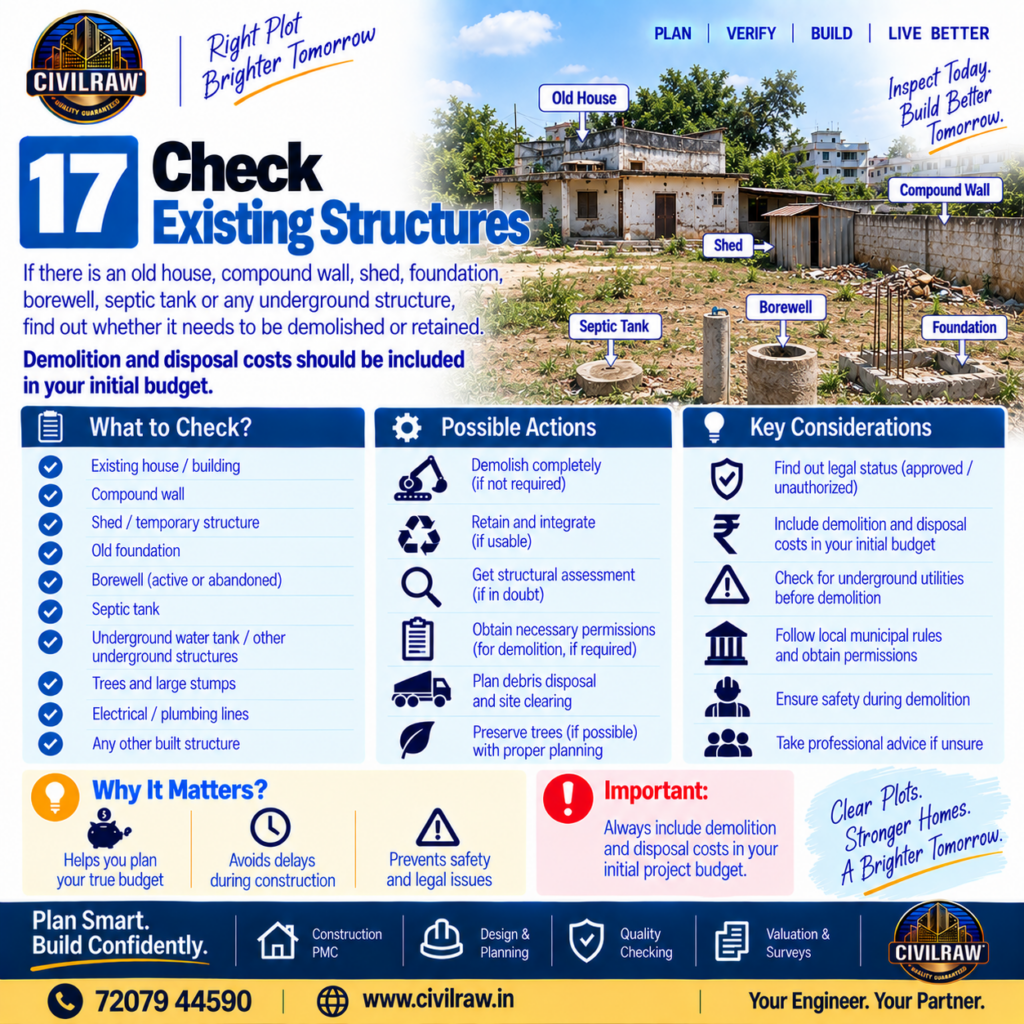
- House
- Compound wall
- Shed
- Foundation
- Borewell
- Septic tank
- Underground structure
find out whether it needs to be demolished or retained.
Demolition and disposal costs should be included in your initial budget.
18. Check Water Availability
Ask:
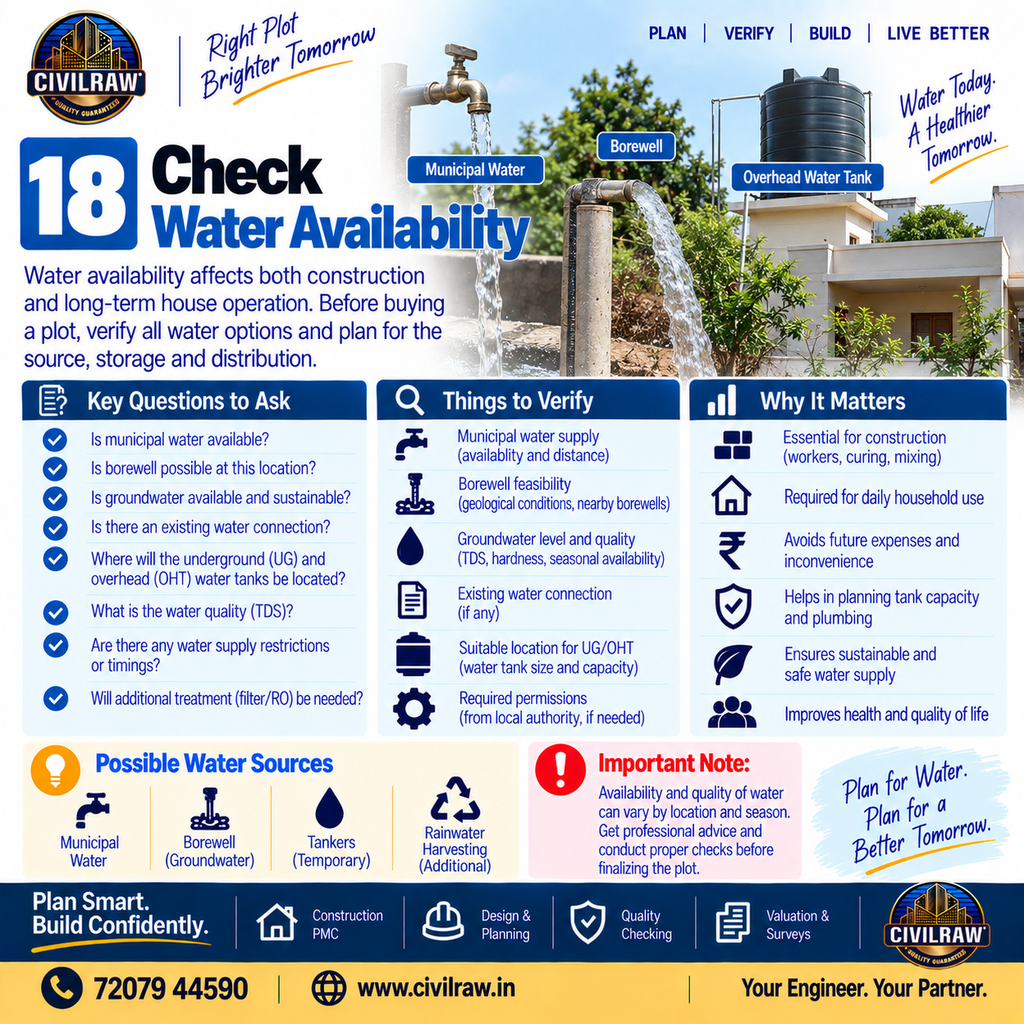
- Is municipal water available?
- Is borewell possible?
- Is groundwater available?
- Is there an existing connection?
- Where will the water tank be located?
Water availability affects both construction and long-term house operation.
19. Check Drainage and Sewer Connection
Determine:
Where will wastewater go?
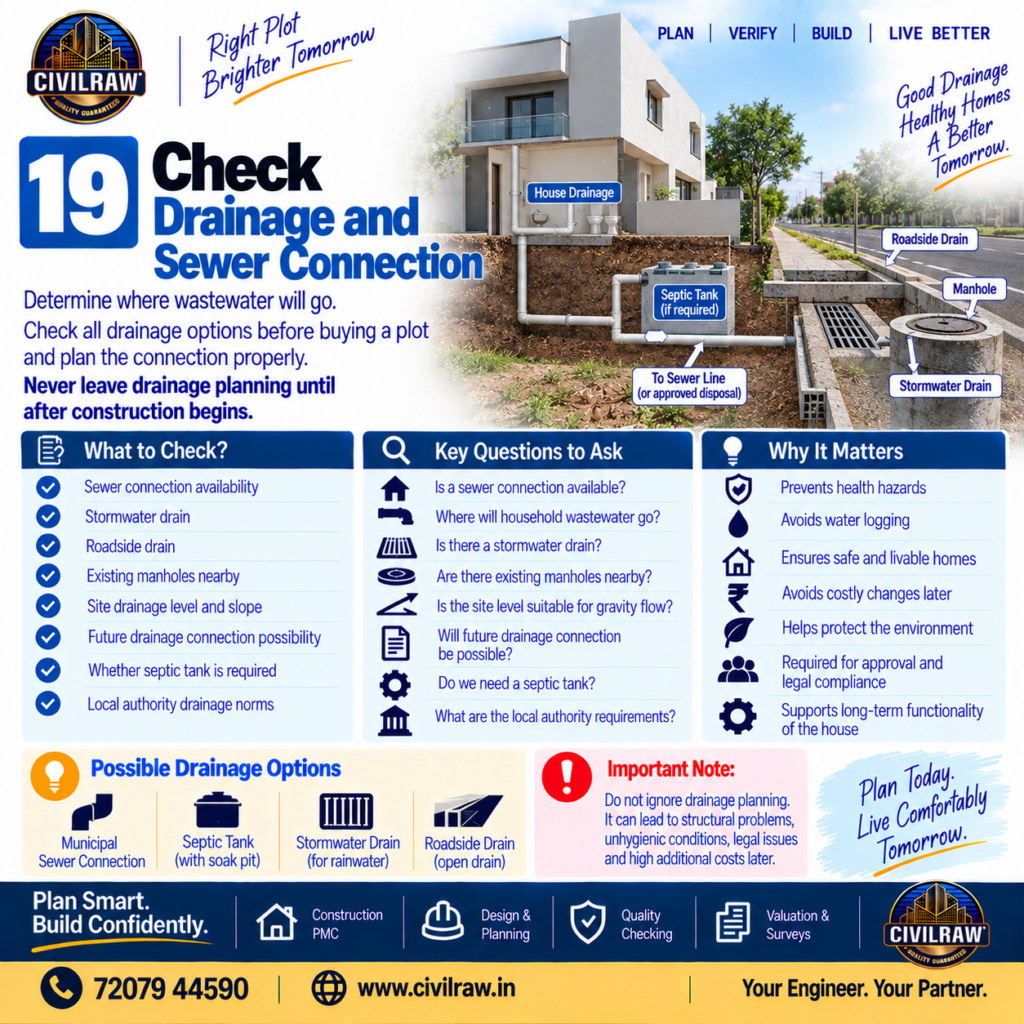
Check:
☐ Sewer connection
☐ Stormwater drain
☐ Roadside drain
☐ Existing manholes
☐ Site drainage level
☐ Future drainage connection
Never leave drainage planning until after construction begins.
20. Check Electricity Access
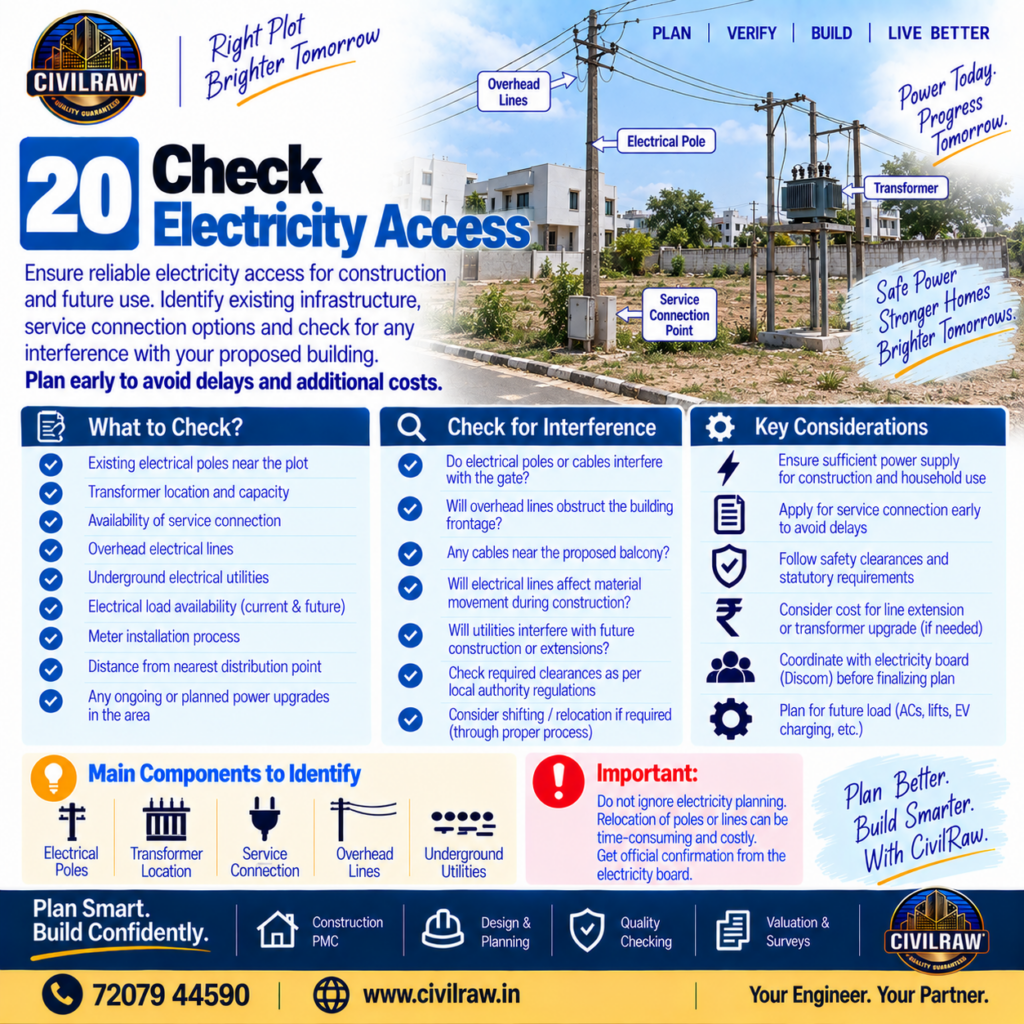
Identify:
- Existing electrical poles
- Transformer location
- Service connection
- Overhead lines
- Underground utilities
Also check whether electrical poles or cables interfere with:
- Gate
- Building frontage
- Balcony
- Crane/material movement
- Future construction
21. Check Neighboring Buildings
Look at surrounding properties.
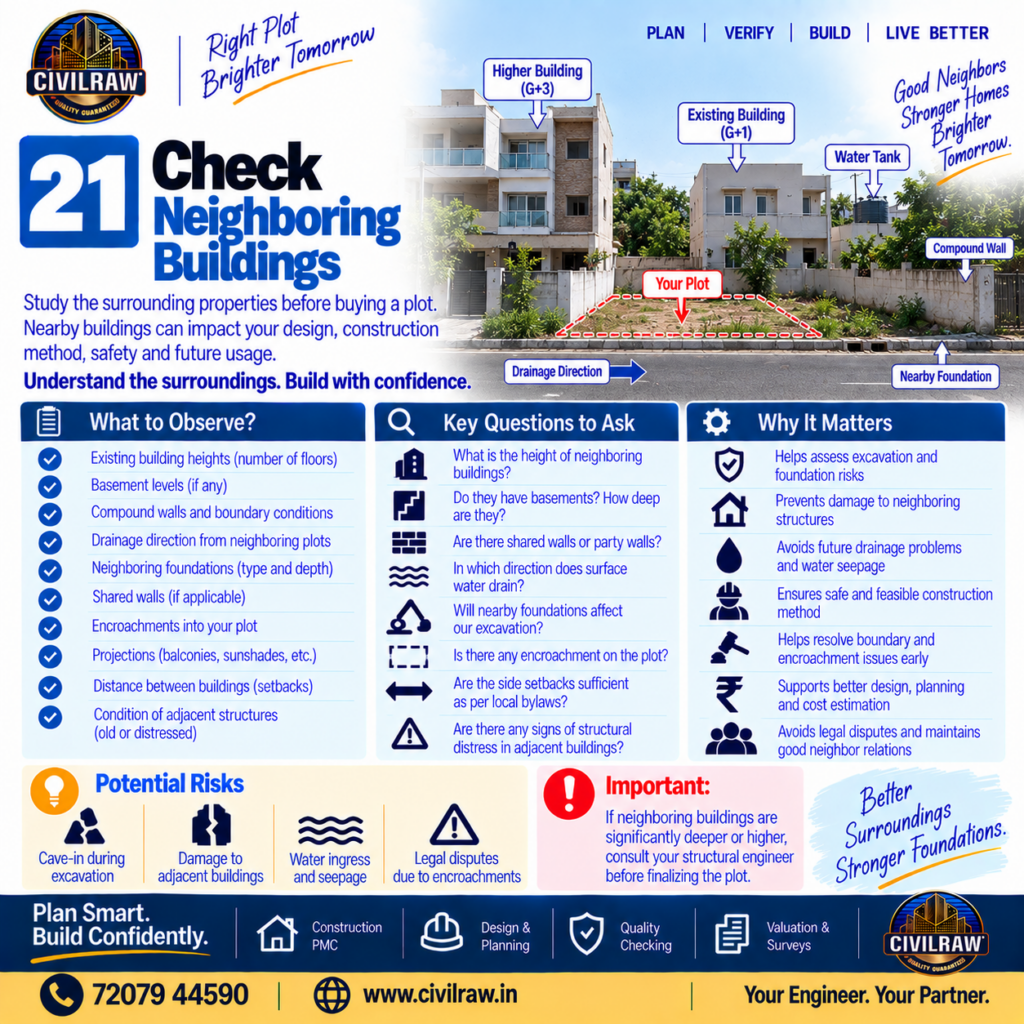
Observe:
- Existing building heights
- Basement levels
- Compound walls
- Drainage direction
- Neighboring foundations
- Shared walls
- Encroachments
If neighboring buildings are significantly deeper or higher, discuss potential excavation and foundation risks with your engineer.
22. Check Construction Access
Imagine your construction site before buying the plot.
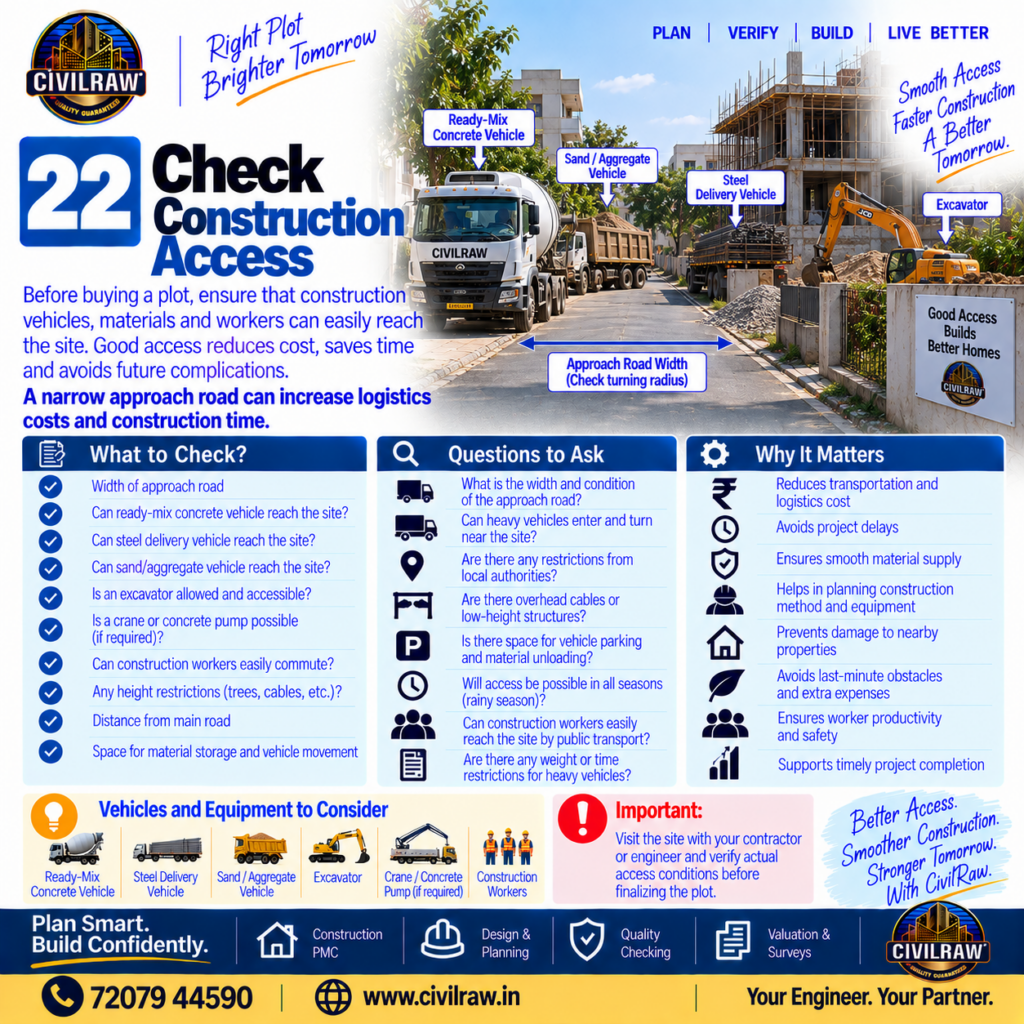
Can the following reach the site?
- Ready-mix concrete vehicle
- Steel delivery vehicle
- Sand/aggregate vehicle
- Excavator
- Crane/pump where required
- Construction workers
A narrow approach road can increase logistics costs and construction time.
23. Check Parking Feasibility
Don’t assume:
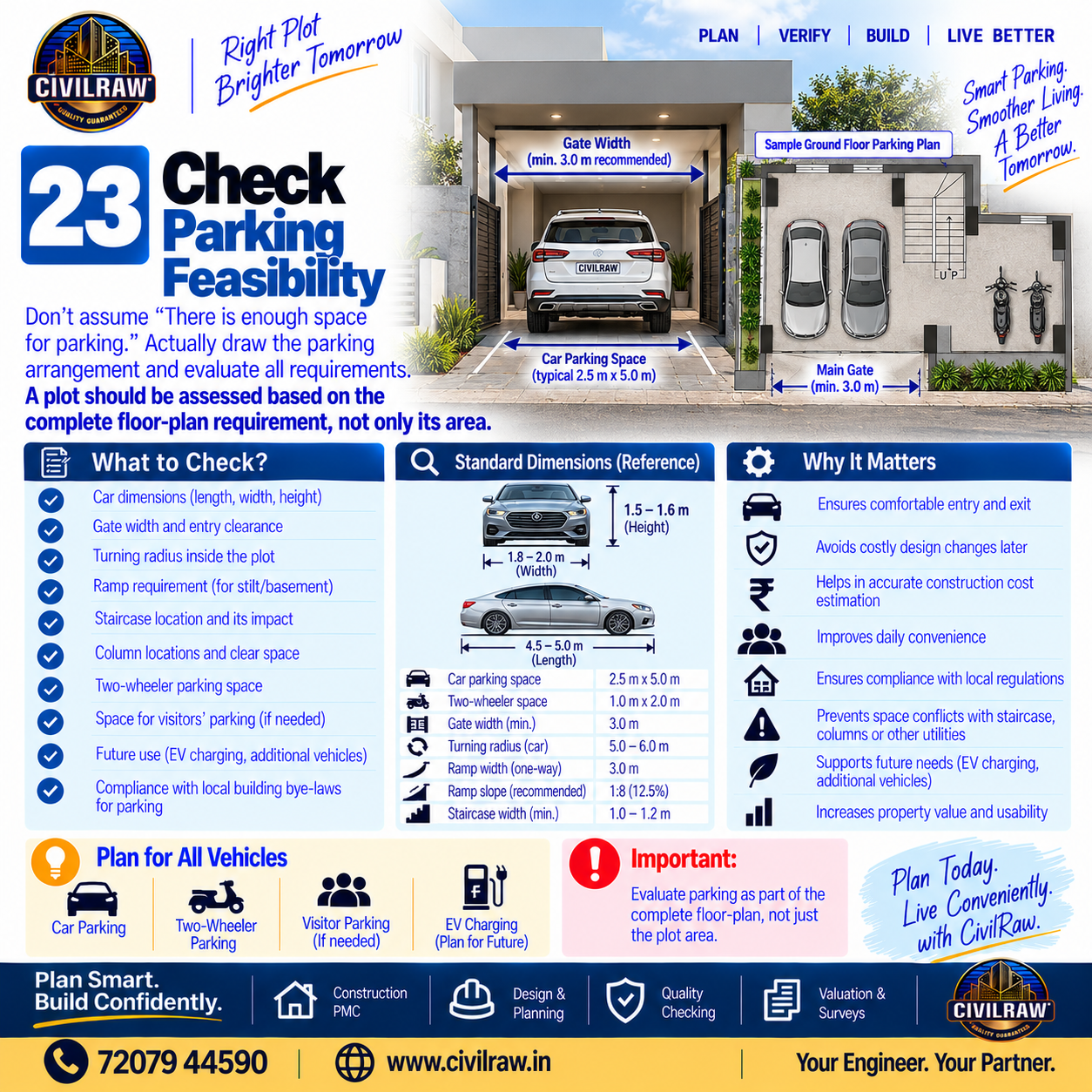
“There is enough space for parking.”
Actually draw the parking arrangement.
Check:
- Car dimensions
- Gate width
- Turning radius
- Ramp requirement
- Staircase location
- Column locations
- Two-wheeler parking
A plot should be evaluated based on the complete floor-plan requirement, not only its area.
24. Check Sunlight and Ventilation
Before buying, understand the orientation.
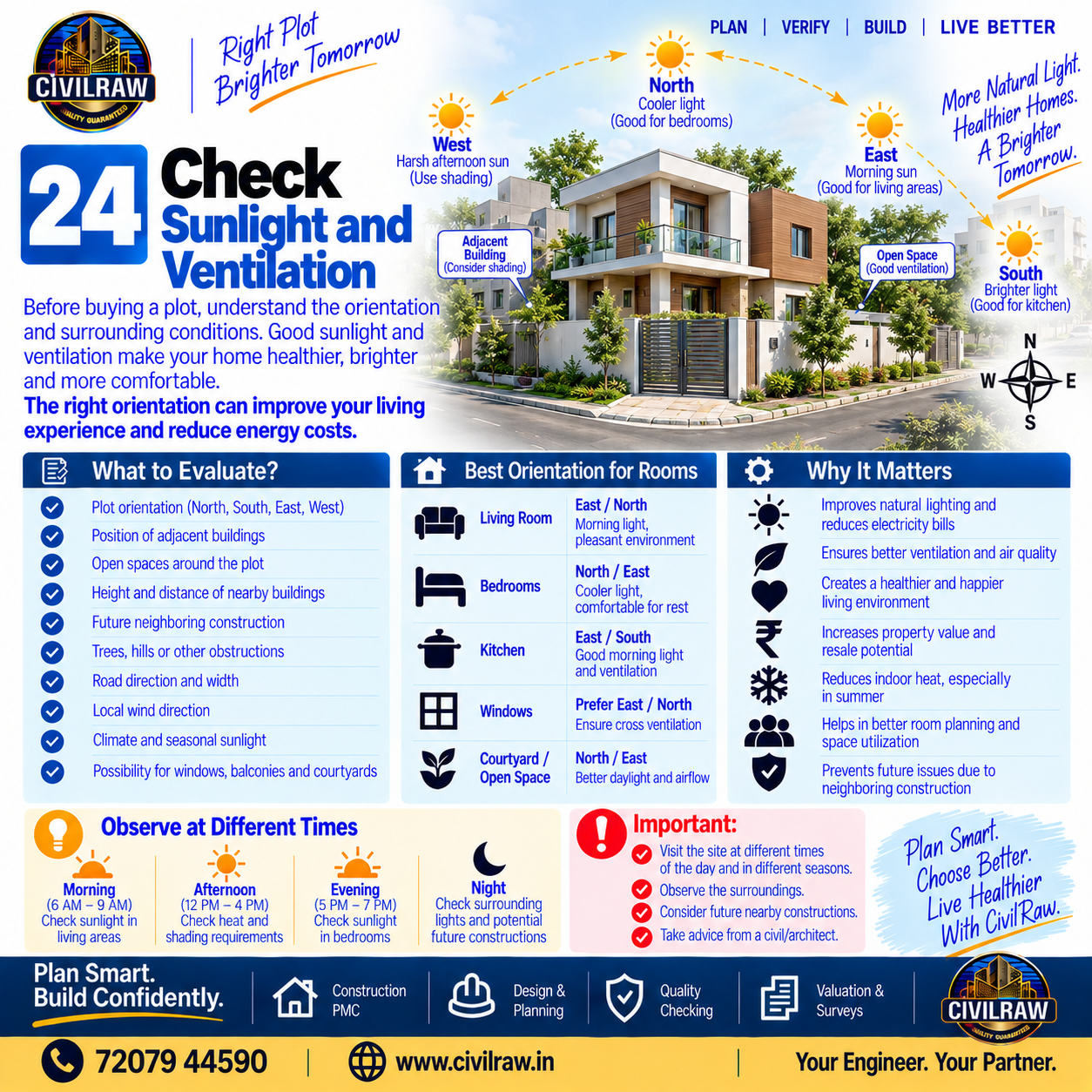
Evaluate:
- North
- South
- East
- West
- Adjacent buildings
- Open spaces
- Future neighboring construction
This helps determine the potential for:
- Living-room orientation
- Bedrooms
- Kitchen
- Windows
- Ventilation
- Courtyard/open space
25. Check the Construction Budget — Not Just the Land Price
This is where many homeowners make a mistake.
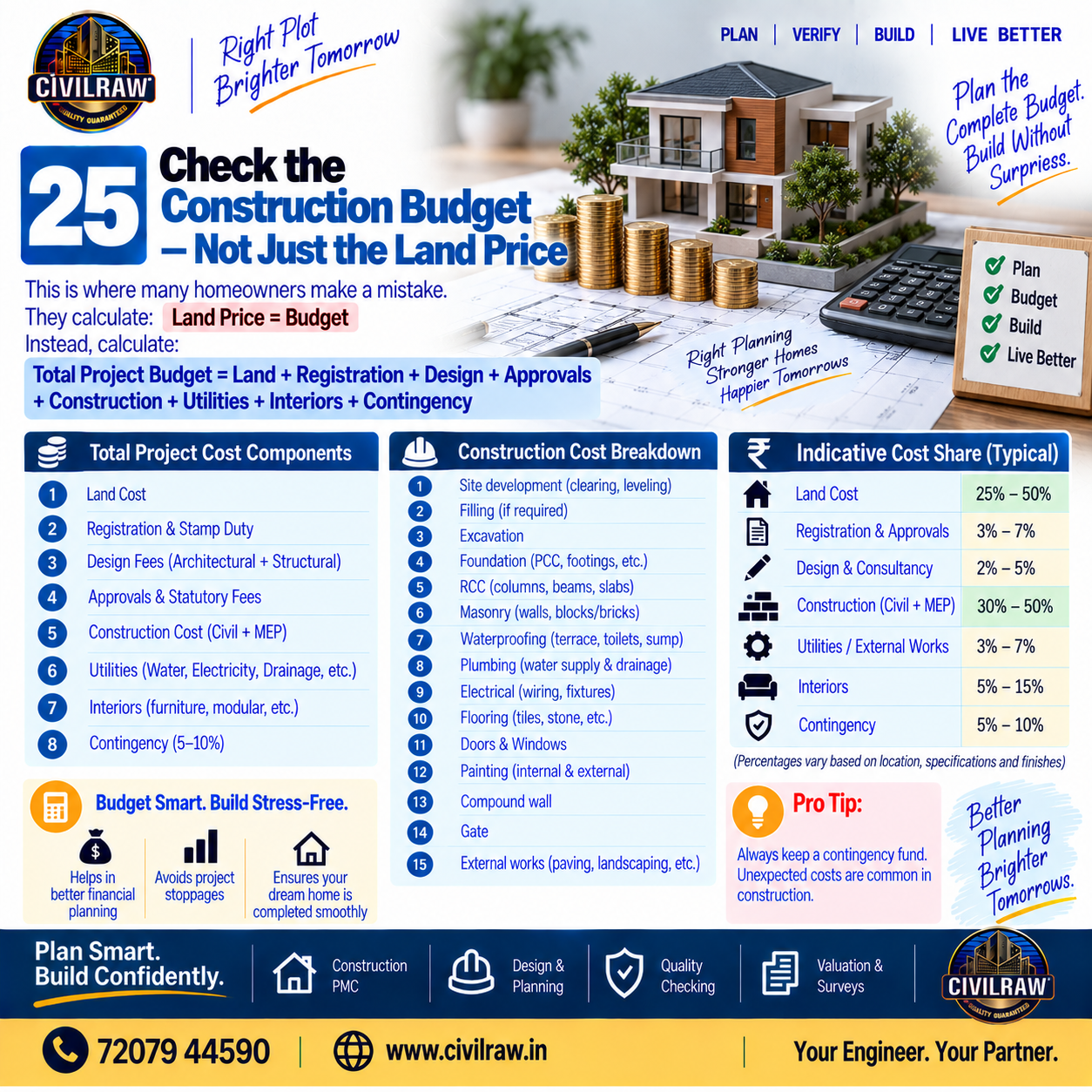
They calculate:
Land Price = Budget
Instead, calculate:
Total Project Budget = Land + Registration + Design + Approvals + Construction + Utilities + Interiors + Contingency
For construction planning, also consider:
- Site development
- Filling
- Excavation
- Foundation
- RCC
- Masonry
- Waterproofing
- Plumbing
- Electrical
- Flooring
- Doors/windows
- Painting
- Compound wall
- Gate
- External works
26. Prepare a Preliminary Construction Feasibility
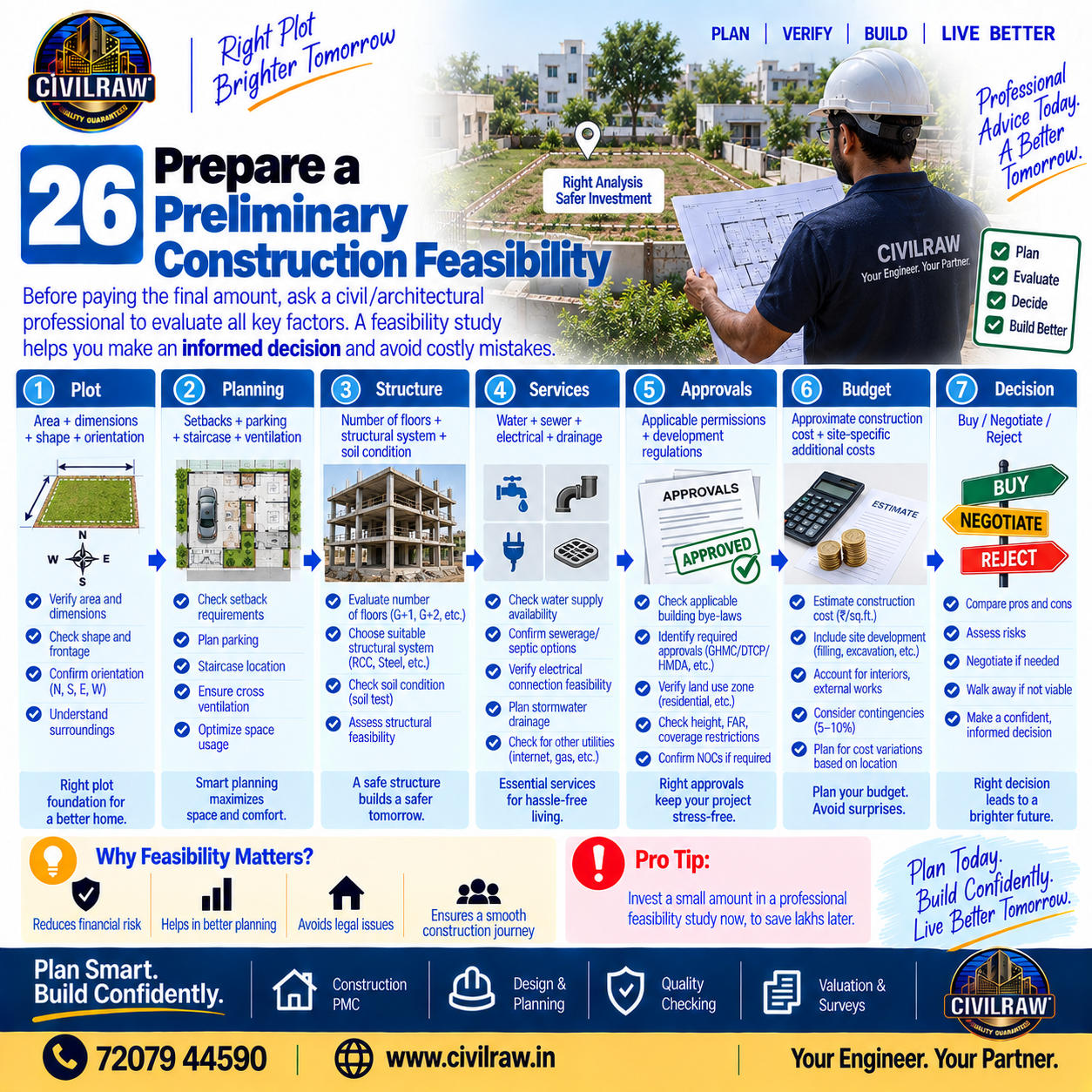
Before paying the final amount, ask a civil/architectural professional to evaluate:
Plot
Area + dimensions + shape + orientation
↓
Planning
Setbacks + parking + staircase + ventilation
↓
Structure
Number of floors + structural system + soil condition
↓
Services
Water + sewer + electrical + drainage
↓
Approvals
Applicable permissions + development regulations
↓
Budget
Approximate construction cost + site-specific additional costs
↓
Decision
Buy / Negotiate / Reject
🚨 10 Red Flags You Should Never Ignore
- Seller refuses independent document verification.
- Plot dimensions don’t match documents.
- Boundary is unclear.
- Road access is disputed.
- Plot is significantly lower than surrounding roads.
- Standing water is visible.
- Land appears to be uncontrolled filled soil.
- Layout approval/documentation is unclear.
- Proposed number of floors may not be permissible.
- Seller pressures you to pay immediately before verification.
📋 Final Residential Plot Buying Checklist
| Check | Status |
|---|---|
| Ownership verified | ☐ |
| Title verified | ☐ |
| Encumbrance checked | ☐ |
| Survey number verified | ☐ |
| Layout approval checked | ☐ |
| Plot dimensions surveyed | ☐ |
| Plot area confirmed | ☐ |
| Four boundaries verified | ☐ |
| Road width checked | ☐ |
| Road access confirmed | ☐ |
| Plot level checked | ☐ |
| Drainage checked | ☐ |
| Flood/waterlogging risk checked | ☐ |
| Soil condition investigated | ☐ |
| Filling checked | ☐ |
| Setbacks assessed | ☐ |
| Building feasibility checked | ☐ |
| Number of floors assessed | ☐ |
| Parking feasibility checked | ☐ |
| Water availability checked | ☐ |
| Sewer/drainage connection checked | ☐ |
| Electricity access checked | ☐ |
| Construction access checked | ☐ |
| Preliminary floor plan checked | ☐ |
| Preliminary construction budget prepared | ☐ |
🏗️ CivilRaw’s Recommended Approach
Don’t ask only:
“Is this plot good?”
Ask:
“Can I legally and technically build the house I want on this plot, within my budget?”
That is the more useful question.
Before purchasing a plot:
1. Legal verification
Confirm ownership, title, encumbrances and relevant approvals.
2. Physical survey
Confirm dimensions, area, boundaries, levels and road access.
3. Construction feasibility
Check setbacks, parking, floor-plan possibilities, drainage and services.
4. Soil assessment
Understand whether soil/filling conditions could affect foundations and cost.
5. Preliminary budget
Estimate the complete project rather than looking only at construction rate per sq.ft.
Suggested Infographic Structure
TITLE:
BEFORE YOU BUY THAT PLOT 🏠
25+ Checks Every Homeowner Should Complete
Use a simple flow:
LEGAL → SURVEY → SITE → SOIL → PLANNING → SERVICES → BUDGET → BUY
Then highlight six major warning areas:
📄 Documents
📐 Dimensions
🌧️ Drainage
⛏️ Soil
🏗️ Buildability
💰 Total Cost
Final CTA
“Buy the right plot. Then build the right house.”
CivilRaw – Built for Homeowners.

Planning Your Construction?
Don't rely on guesswork. Get a transparent, engineer-backed estimate for your home.
Get Cost Estimate